
Bikepacking Wyoming on the Great Divide: from Yellowstone to the Great Divide Basin
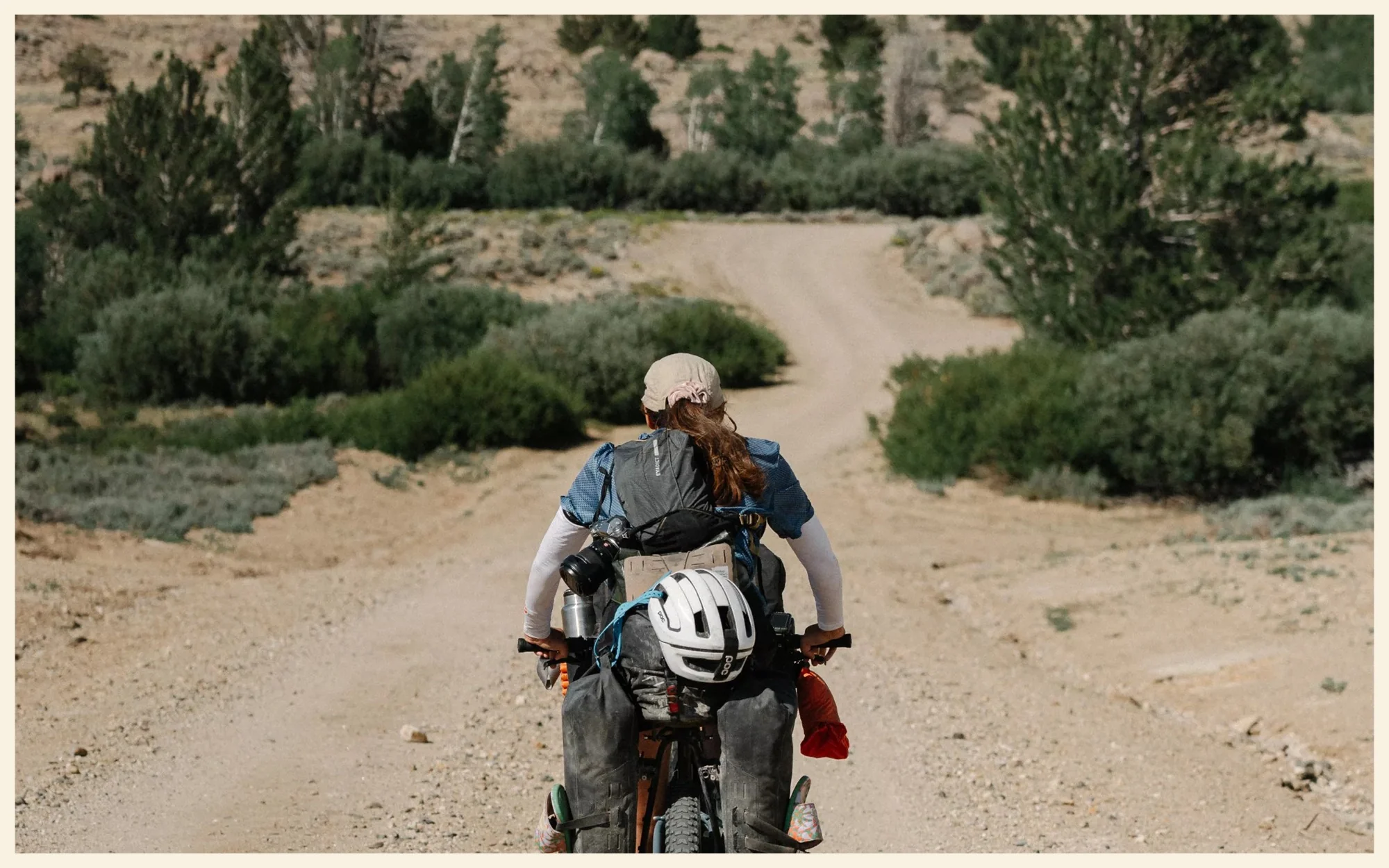
Wyoming is the state of extremes: bison by the roadside, passes at nearly 3,000 m and a desert without a single tree! In late July 2024, we left Montana via Idaho, made a detour through Yellowstone National Park, then rejoined the Great Divide Mountain Bike Route (GDMBR) at Grand Teton. It took us to Pinedale, across the Great Basin to Rawlins, then on toward Colorado: 1,155 km and 10,782 m of climbing in nineteen days.
In the podcast, Julien and I told Jean-Mi everything as it happened. Here, I go back over the moments that stuck with us the most, and give you what you need to know to ride in Wyoming: the route, the stages, how to visit Yellowstone by bike, where to sleep, and how to cross the Great Basin without ending up as a raisin.
In short
- When: July 21 to August 8, 2024, the two of us, in the height of summer.
- The route: from the Red Rock Lakes refuge (Montana) to the gates of Colorado, via Idaho, West Yellowstone, Yellowstone and Grand Teton national parks, Pinedale, Atlantic City, the Great Basin and Rawlins.
- The ride: 1,155 km and 10,782 m of climbing over 14 stages (77 hours in the saddle), including town rides: our short trips around town on rest days in Pinedale and Rawlins.
- Wildlife: two moose in our campground, a bear cub on a sandy track, elk, bison, two wolves through binoculars… and an army of mice.
- Sleeping: hiker-biker sites in the park campgrounds (around 10 dollars per person), a warming hut, our Warmshowers host in Pinedale and a backyard in Atlantic City.
- The challenge: the Great Basin, a desert with no trees and no drinking water, with about ten liters of water each and up to 53 °C in the sun on our bike computer.


Our bike route through Wyoming
- Upper Lake → Big Springs: 55 km to leave Montana, and a night in a campground near Big Springs, Idaho.
- Big Springs → West Yellowstone: 30 km on a sandy forest road. West Yellowstone, on the Montana side, is one of the park’s entrances.
- Scouting Yellowstone: 58 km out and back from West Yellowstone, then a rest day.
- West Yellowstone → Canyon Village: 68 km for our first day in the park.
- Canyon Village → Grant Village: 75 km among geysers, hot springs and bison.
- Grant Village → Colter Bay, in Grand Teton National Park: 67 km.
- Colter Bay → Jenny Lake: 39 km, including a trail we should never have taken.
- Jenny Lake → a mountain lake: 87 km and 1,280 m of climbing, back on the Great Divide.
- The lake → Union Pass → the Strawberry Warming Hut: 71 km and 1,334 m of climbing, two passes at nearly 3,000 m, and a night in a warming hut.
- The Strawberry Warming Hut → Pinedale: 100 km, including 60 km of headwind. Five days at Christy’s, our Warmshowers host.
- Pinedale → Atlantic City: 140 km in the Great Basin, my longest day ever on a bike.
- Atlantic City → A&M Reservoir: 128 km in the heat.
- A&M Reservoir → Rawlins: 90 km to get out of the desert, and a rest day.
- Rawlins → River Bend Campground: 117 km and 1,539 m of climbing, our last day in Wyoming.
| Day | Stage | Km | D+ | Time |
|---|---|---|---|---|
| 1 | Upper Lake → Big Springs (Idaho) | 55 km | 391 m | 3h45 |
| 2 | Big Springs → West Yellowstone | 30 km | 244 m | 2h37 |
| 3 | Scouting Yellowstone, out and back | 58 km | 300 m | 3h20 |
| 4 | West Yellowstone → Canyon Village | 68 km | 729 m | 4h54 |
| 5 | Canyon Village → Grant Village | 75 km | 578 m | 4h56 |
| 6 | Grant Village → Colter Bay | 67 km | 479 m | 3h46 |
| 7 | Colter Bay → Jenny Lake | 39 km | 324 m | 3h08 |
| 8 | Jenny Lake → mountain lake | 87 km | 1,280 m | 6h20 |
| 9 | Lake → Union Pass → Strawberry Warming Hut | 71 km | 1,334 m | 6h21 |
| 10 | Strawberry Warming Hut → Pinedale | 100 km | 529 m | 6h30 |
| – | Town rides in Pinedale (3 days) | 18 km | 42 m | 1h21 |
| 11 | Pinedale → Atlantic City | 140 km | 1,418 m | 7h51 |
| 12 | Atlantic City → A&M Reservoir | 128 km | 1,098 m | 8h50 |
| 13 | A&M Reservoir → Rawlins | 90 km | 401 m | 4h42 |
| – | Town ride in Rawlins | 14 km | 96 m | 0h58 |
| 14 | Rawlins → River Bend Campground | 117 km | 1,539 m | 7h57 |
| Total from Red Rock Lakes to southern Wyoming | 1,155 km | 10,782 m | 77h14 |
Times are moving times, breaks not included. Town rides are our short trips around town on rest days.
All our tracks are on our Route & Stats page, “Banff > Sargents” section, and the details of each day are on Julien’s Strava.


Wyoming on the Great Divide
The official Great Divide route doesn’t go through Yellowstone. It enters Wyoming between the two national parks, on a little-used track, Grassy Lake Road, and reaches Colter Bay, on the shore of Jackson Lake (Adventure Cycling Association). We made a detour via West Yellowstone to visit the park, before rejoining the route at Grand Teton.
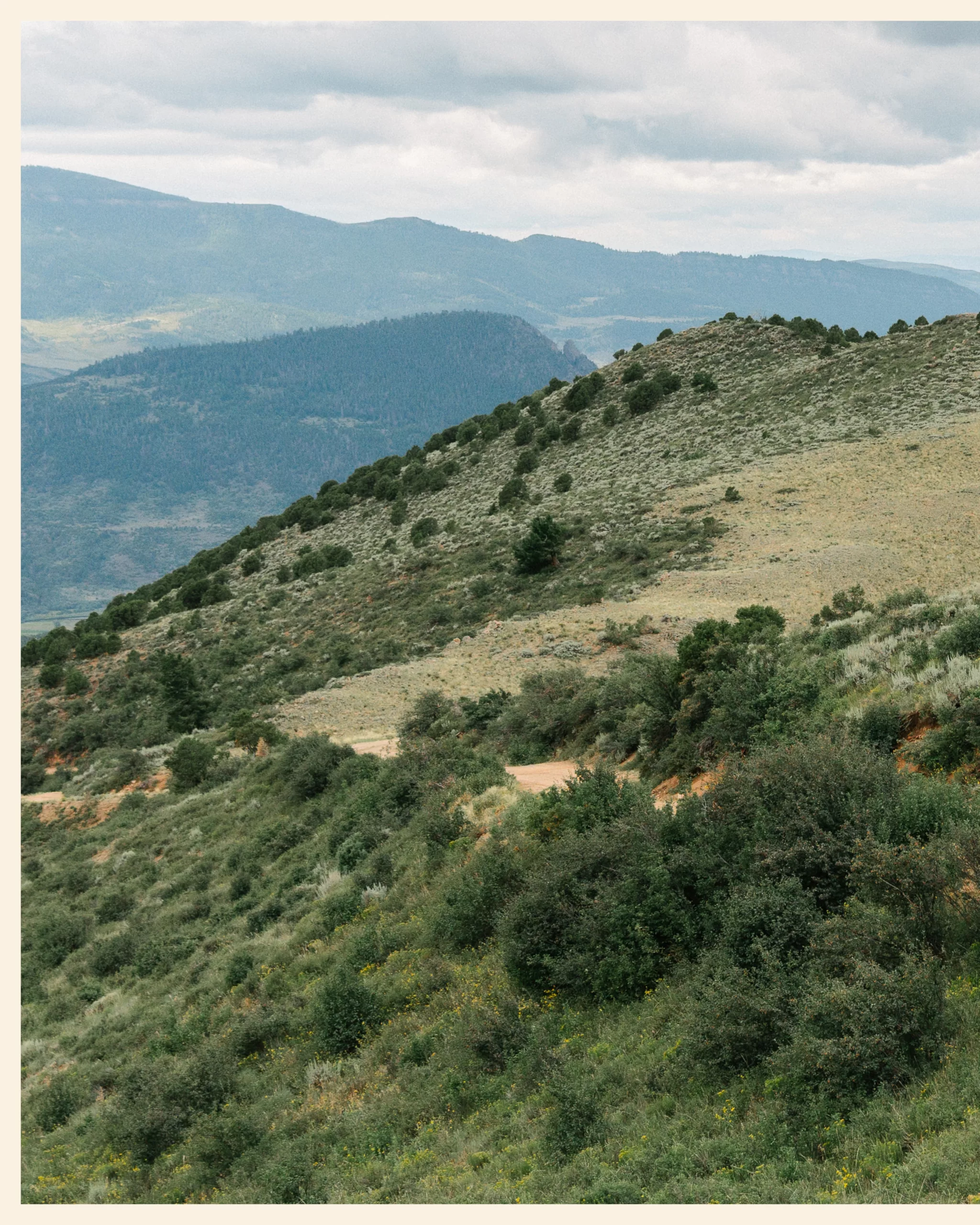
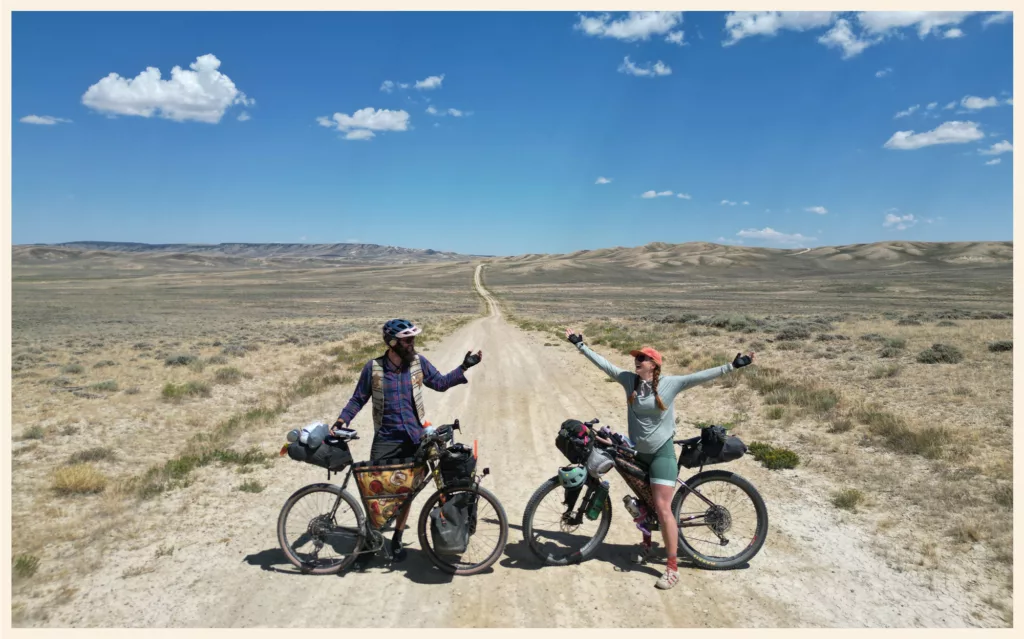
After that, the route climbs to the passes, drops down to Pinedale, then crosses the Great Divide Basin, which cyclists simply call the Great Basin: about 190 km of treeless desert between Atlantic City and Rawlins. It’s the only place where the Continental Divide splits in two. Rain falling between the two lines reaches neither the Atlantic nor the Pacific: it evaporates on the spot. After Rawlins, the route leaves the desert and climbs into the forests of the Sierra Madre, on the Colorado border.
What we lived through in Wyoming
Goodbye Montana, hello Idaho
We leave Montana with a slightly heavy heart. It’s the first state we crossed, we spent just over three weeks there, and it feels like we lived there for years. It’s the state that taught us America: fast food, free-roaming herds in the middle of the tracks, and the joy of spotting a gas station miles away.
Barely across the Idaho line, a ranch by the road seems to be selling drinks. We’re thirsty, we stop. It’s not a store: it’s a camp where teenagers come to learn the cowboy trade, and the staff are waiting for the next batch. Two free lemonades later, we’re chatting in the shade about what changes from one state to another. Their answer leaves us speechless: Montana has no sales tax, so prices are lower there than elsewhere. And we thought Montana was outrageously expensive… The first supermarket in Idaho proves them right: it’s even more expensive!
To celebrate our new state, we still treat ourselves to fresh chicken for a coconut curry rice at the campground near Big Springs, five minutes from the supermarket. The pot is simmering when two moose walk through the campground. They head straight on, without a glance at us, toward the little river where they come to graze on algae. Five meters separate us from their huge antlers! In the evening, the whole gang joins us: Lynn and Chip, our grandparents of the road, then Dino, Suzy, Gail and John.
The bear cub on the sandy track
At breakfast, Suzy and Dino warn us. To get to West Yellowstone, the forest road is full of sand, and Crazy Guy on a Bike, the bike travel journal site everyone checks, strongly advises against it. “Take the highway.” Julien and I look at each other. In a few months, we want to ride the Baja Divide, in Baja California, a route known for its sand. If we can’t get through here, we might as well change plans right now. We take the track!
The sand is there all right, but so are our tires. Our Parisian friends call us the tractors because of our huge wheels, and for once, it’s a compliment! We don’t put a foot down; we just nearly go over two or three times. We’re chatting away when a crackling rises from the bushes to our right. Faint at first, then louder and louder. A bear cub bursts out and crosses in front of our wheels!
A cub means a mother nearby. And a mother who thinks you’re threatening her cub, or who finds herself separated from it by two bikes, can charge. Total panic! We shout as loud as we can, not to call for help (there’s no one for miles), but so she knows exactly where we are. On our left, the track runs along a steep drop. The cub tries to climb it, slips, hangs on, tries again. A few meters further, a fallen tree blocks the track, impossible to get over or under. We have to lift the bikes and go around it at the edge of the drop, without ever stopping shouting.
We arrive in West Yellowstone safe and sound, without ever seeing the mother. Black bear or grizzly? Impossible to say: the cub was too small to spot the hump grizzlies have between their shoulders. Either way, the test is conclusive. Sand, we can do. Bears, we’d rather avoid!


Yellowstone, traffic jams and bison
The plan was simple: leave the hotel at 4:30 a.m. to be the first into the park. Guess what: we leave at 9:30! Yellowstone has its codes, and we learn them fast: when cars slow down and form a little jam, an animal isn’t far. The first one shows up within five minutes. A family of elk grazes by the roadside, huge and nonchalant. We slip into the middle of the line, protected by the cars on each side, and inch forward. In a jam, you never know whether people stopped for a mouse or for a bear.
The rest of the time, it’s a different story. Drivers go fast and scan the meadows for bears, without seeing the cyclist on the shoulder. If they can’t see a bike one meter away, how do they spot a wolf three hundred meters off? A mystery! In the evening, we pitch the tent at the Canyon Village campground, on a site reserved for cyclists and hikers.
The next day, we set off in search of bison, the park’s emblem. Along the way, Yellowstone dazzles us: bubbling green water, caramel-colored waterfalls, fields of brilliant white rock. The first bison appear in a large meadow, about a hundred meters away. Even from afar, they’re mountains of fur! Further on, a crowd armed with binoculars is watching two black wolves, two tiny dots three or four hundred meters away. I catch myself feeling a little sorry for these tourists. Since Canada, we’ve come across so many animals up close, alone, with no one around.
At the start of a short walk, while we answer questions about our bikes (to RV families, we’re UFOs), the excitement builds. We turn around: a huge black mass is passing behind us, heavy-footed, breathing powerfully. We step away fast; a bison can charge without warning. Around us, many people stay put, phone in hand. A ranger arrives and shouts himself hoarse: “Move away from the bison!” Hardly anyone moves. I imagine how weary he must be of repeating it every day to people who just want their photo.
On the way back, another bison gets agitated, about twenty meters away. He lowers his head, pushes a tree, and uproots it. Then a second. Then a third! For five to ten minutes, the crowd stands open-mouthed in front of this show of strength. That evening, at the Grant Village campground, we promise ourselves to keep our distance.
Leaving the park
Yellowstone is huge; you could spend days there. A ranger tells me, though, that most visitors only stay five or six hours before heading on to Grand Teton. We had planned four days. On the morning of the third, we crack. It’s not the park, it’s the traffic: after weeks of empty tracks in Montana, riding inches from RVs wears us out. We spend our days clinging to the handlebars. Too bad for Old Faithful, the park’s most famous geyser and every tourist’s must-see: we’re leaving!
At the campground store in Grant Village, the cashier picks up on our accent. “You’re French? It’s the Olympics over there, right? I think there was an attack, something with trains.” He doesn’t know more. No signal in the park, no way to check: we leave with our coffees and a knot in our stomachs. We later learn it was sabotage on the high-speed rail lines on the day of the opening ceremony, with no casualties.
At the park entrance sign, we stop for the souvenir photo. A Brazilian family is waiting their turn. One of the daughters asks for our Instagram: she lives in Los Angeles, and if we come through, we’ll have a roof. Little by little, our map of the United States fills up with friendly addresses.
At the first restaurant after the park, it’s pouring. We wait under the porch for the shower to pass, when a customer comes out and hands us his takeout box: “I couldn’t finish it.” Macaroni and nuggets! I could cry. We reach Colter Bay, on the shore of Jackson Lake in Grand Teton National Park, soaked to the bone. The rain stops just long enough to pitch the tent and wolf down a sandwich. We’re barely inside when the storm breaks. Nice and dry, we sleep like babies!
Jenny Lake, or why I’m confiscating Julien’s GPS
In the morning, a restaurant in Colter Bay offers an all-you-can-eat breakfast. We knock on our campground neighbor’s door, a retired cyclist, to invite him. Between two plates, he tells us how he got here. Retired for two years, he felt himself sinking: get up, TV, junk food, and repeat, every day. One morning, he called his son: “I’m leaving.” That was the start of his Great Divide. It reminds me of another cyclist, in his thirties, newly married and soon to be a dad: he’s riding the Great Divide now, because afterwards he wants to be there for his child. On this route, everyone has their reason. We go back for seconds countless times. I think the staff can’t wait for us to leave.
Too late to reach the planned section of the Great Divide: we head for Jenny Lake, about twenty kilometers away by road. Except Julien has spotted something better. Ride along the lake! On the map, it’s gorgeous. In reality, it’s a hiking trail, too narrow for our bags. We push, we pull, we pass the bikes along single file. An ordeal within the ordeal. That’s it: I’m confiscating all his navigation tools!
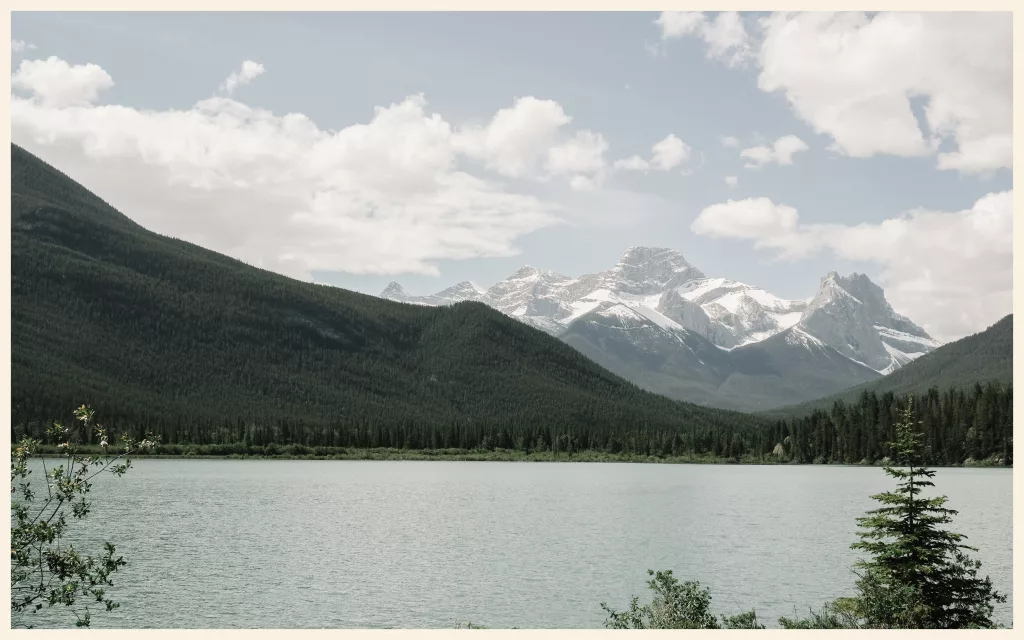
I have to give him one thing, though: the view. The lake is a still blue, the sky is reflected in it, and behind it rises the Grand Teton, at more than 4 000 m. It looks like a beach at the foot of a mountain. In a small cove, we treat ourselves to a midnight swim… at 3 p.m.! In the evening, at the Jenny Lake campground, we meet up with the Fabulous Four, our four Brits, Suzy, Dino, Gail and John. We also meet George, an Englishman riding at roughly our pace. We agree to set off together the next day.


George, the Swiss and race mode
The next day, we’re the first to pack our bags and set off alone on a still-empty paved road. Not a truck, not an RV. An hour and a half later, four identical bikes are waiting outside a café: same Canyon Grizls, same bags, same saddles. Inside, one-dollar bills cover the entire ceiling and empty bottles serve as decor. The waiter looks at the end of his rope, and a poster announces that the bar is for sale for a little over 50 000 dollars. The four cyclists speak a mix of French and German: a Swiss family traveling as four. George joins us, we put the world to rights, then everyone sets off again. Except us. We pack up the tent in record time, but in front of a coffee, we just can’t leave.
The sky clouds over. The wind picks up, a few drops fall, and we’re riding in the open. I stop to put on my rain jacket. When I look up, Julien has spotted a figure climbing the pass far ahead: George. And off he goes! He learned his technique with a mental coach back when he did ultra-distance. He dissociates from his body and watches himself pedal in the third person, like in a video game where you have to mash a button to pass the other racers. No more pain, no more shortness of breath. Half an hour later, just before the summit, he catches George, who can’t believe his eyes! I find them both sheltering from the rain.
The three of us finally leave the asphalt for a gravel track. The sun comes back, the road runs between pines and wide plains. After a few hours, the forest suddenly opens onto a lake at the foot of enormous mountains. The three of us look at each other, and no one needs to say it: we’re sleeping here!
Crying with freedom
We get up before the sun. After a few kilometers of gravel, the track joins a paved road that descends, for a long time, without a single pedal stroke. No noise, no cars, pines as far as the eye can see, a little fresh air on your face. I couldn’t say why, but I feel the tears coming. This is freedom. Ahead of me, Julien turns around: he’s crying too. There we are, the two of us, sobbing on a descent, connected to each other and to everything around us.
At the bottom, a café promises an all-you-can-eat breakfast and a chance to restock. The Swiss are already at a table. Bad news: the owner has nothing to sell, his stock is empty. So we raid the buffet! Julien is on his fifteenth slice of bacon when we ask the awkward question: where do we sleep tonight? The Swiss mention a cabin on the way, but refuse to show us where on the map. It seems they want to keep it for themselves.
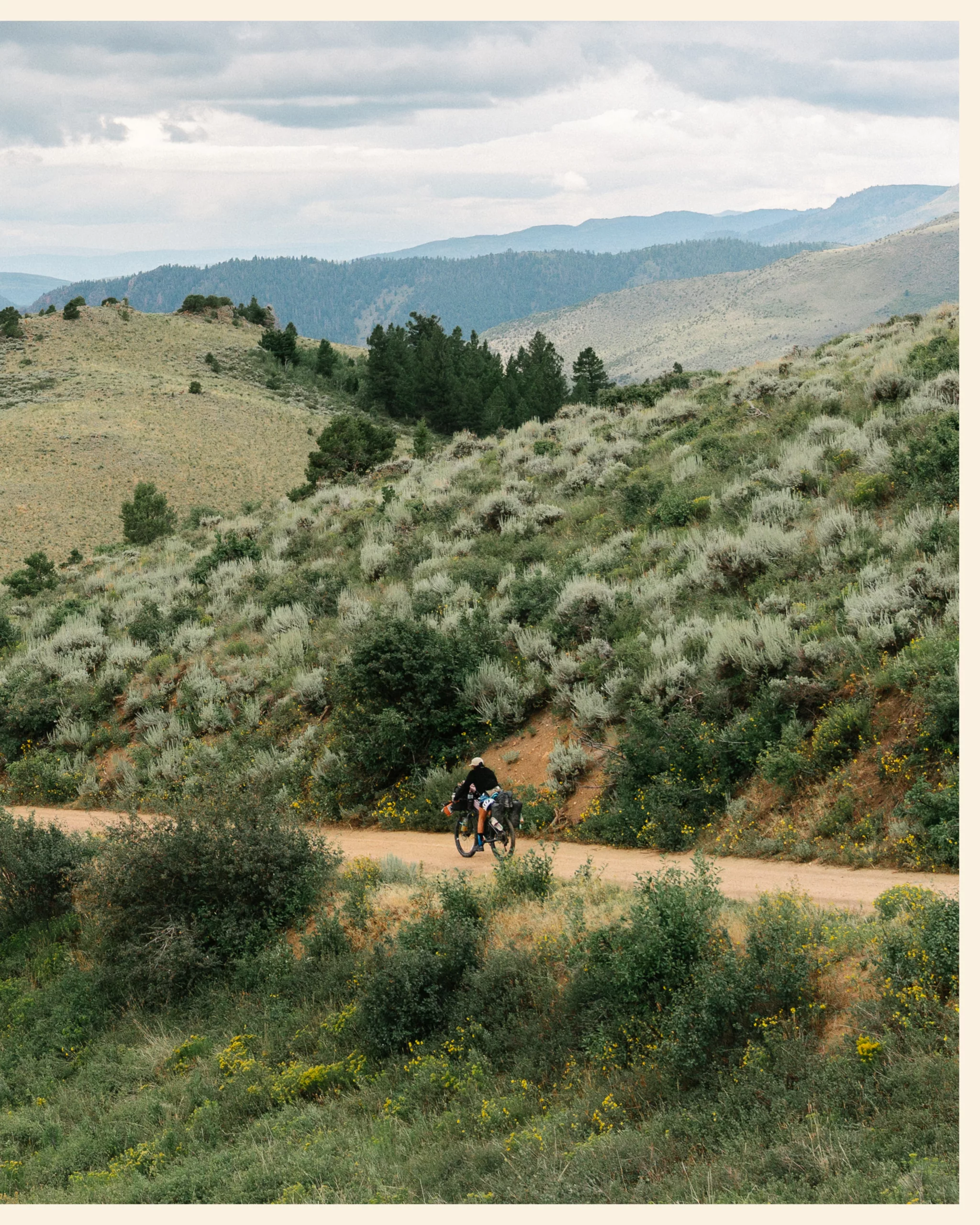
To reach Pinedale before hunger catches up with us, we have to tackle two big passes back to back. The first, Union Pass, tops out at 2 810 m on the Continental Divide: long, but steady. We drop down, then climb a second pass, around 3 000 m. For lunch, granola bars, which we ration. Julien is struggling: when he doesn’t eat, he quickly loses all his energy. At the top, a headwind almost pushes us backward. Signs remind us we’re in grizzly country, so camping just anywhere is out of the question. Night falls, the cold with it, and we start to panic when the cabin finally appears: the Strawberry Warming Hut.
No sign of George’s bike at the door: he must have pushed on to Pinedale. Julien suggests carrying on too. I look at him. He doesn’t need a translation: we’re stopping!

The hut of mice
The Strawberry Warming Hut is a real shelter: an emergency phone, a map, tables, chairs. Pure luxury! We share a ramen dinner with the Swiss and make two rookie mistakes. The first: leaving our food out of the bags, since we’re indoors. The second: not looking around us. Five minutes after rolling out our sleeping pads, there’s scratching. On the wood, on the door, then in our things. The hut is infested with mice. We hear them rummaging through our food, but we’re too lazy to get up. One or two hours of battling ourselves later, we finally put everything away. Too late: they keep running around us, and even over us. Sleepless night.
In the morning, the Swiss leave at 6:30. We dawdle. On the map, the day looks easy: a long descent, then flat. Twenty kilometers later, heads down over the handlebars, we discover the descent. Big rocks, real mountain-bike handling, and every mistake can cost a fall or a broken bike. In our tired state, we have to stay focused, and it drains the batteries. According to Crazy Guy on a Bike, there’s nothing to eat until Pinedale. But at the bottom of the descent, a brand-new restaurant has just opened. On the walls, hunting trophies: moose, deer, mountain lions. At the next table, six or seven buddies in Make America Great Again caps compare their exploits. A mountain lion, a grizzly… Not exactly our vibe. We devour our burgers, listening with half an ear.
There are 60 km left, and the weather serves us the previous day’s headwind again. No shelter. I tuck in behind Julien’s wheel, we both put our heads down, and we don’t look up until Pinedale! At the edge of town, we run into George: the day before, he rode 200 km to sleep in a hotel, in a real bed. We have Christy waiting for us, our Warmshowers host.

140 km across the Great Divide Basin
We were supposed to stay two days at Christy’s. We stay five! She welcomes us like family: a small lake, paddleboarding, a dog who only wants to play, and a music festival where her daughter works. That’s Warmshowers: being let into people’s lives. Julien takes the opportunity to trade his old handlebar, which hurt his wrist, at the bike shop for sealant and brake pads. The new one, a Tumbleweed Persuader, was waiting for him in Yellowstone.
On the morning we leave, at the gas station, we stock up on granola bars, Coke and water: about ten liters each. The forecast says 40 to 50 °C. Other cyclists are stocking up too, and for once, they’re our age. On the Great Divide, we mostly meet retirees, fascinating people, but right now we dream of a gang of friends. There’s Nunzio, from Puerto Rico, and Annie, American, a couple. Others join us. We set off as a group of about ten!
The group rides like the Tour de France. We take turns at the front, chatting from bike to bike. It’s about forty degrees, but clouds hide the sun and the wind pushes us from behind. Up front, Julien and William are flying along at 30 to 35 km/h. The Great Basin is an arid plain as far as the eye can see, no trees, no shelter, endless straight lines. Tough on morale, gorgeous to look at. At the lunch break, in the shade of a few rocks, we’ve already covered 50 km in two hours. That’s where we had planned to sleep. The others are aiming for Atlantic City, a hundred kilometers further. My longest day so far? About a hundred kilometers. We follow them!
Little by little, the group stretches out. We’re the heaviest, not in body weight, in luggage weight. Now and then we catch up with Annie and Nunzio, who nibble bars all day instead of stopping for lunch. Then a climb separates us. At the top, we turn around: the sky is black, streaked with lightning. There are about forty kilometers left, and no choice but to go for it. The last hills before Atlantic City break our legs.
We arrive an hour, an hour and a half after the others. Outside the restaurant, a row of bikes. The whole gang comes out to welcome and cheer us. Julien hugs me and stops his GPS: 140 km! A month ago, if someone had told me I could do that, I would have burst out laughing, then burst into tears. That day, surrounded by such kind people, it wasn’t a punishment. It was “let’s go”.
Atlantic City, a former gold rush town, had 37 residents at the 2010 census. Yet there’s a restaurant, and we eat the best meat of our lives there, from the neighboring herds. Nunzio, vegan for years before going back to meat on the Baja Divide, can’t believe it. For the night, Monique and Bernard welcome cyclists at the bottom of their yard, around their barn. While a dozen tents spring up on the lawn, the master of the house grabs a mic and launches into karaoke with the confidence of the singer of the year. After a day like that, it doesn’t take more: we all cry with laughter!


53 °C and a party in the desert
The next day, we leave first, with a good hour’s head start. The others ride light, almost racing; we want to avoid the heat. No such luck! It gets very hot fast, and the morning climbs don’t help. Our bike computer, a Garmin Edge 1040, shows up to 53 °C in the sun. No shade, anywhere. Stopping means cooking on the spot. Riding at least means feeling a little air on your sweat. My savior of the day: Julien’s UV arm sleeves. I didn’t have any, I hadn’t understood the point, and he lends me his. White, under my clothes, soaked every hour: a little miracle of coolness!
Around noon, a chemical smell floats in the middle of nowhere. Oil? Gas? In the distance, big machines plunge into the ground: drilling wells. Next to them, a shed casts a tiny shadow. We press ourselves against it to wolf down our wraps, until the sun moves round and catches us. All afternoon, the friends who left after us pass us one by one. It wears down my morale. But no one comes back: so there must be water at A&M Reservoir. Lynn and Chip, who came through a few days before us, sent us photos; it was almost full.
We reach the reservoir completely spent. The whole gang is there, with a surprise. Sarah is celebrating six years of marriage, and her husband drove all the way from California to meet her in the desert, with beers, cold water and pizzas. A party in the middle of nowhere! I’m truly happy for them, but I admit it: all I can think about is cold water. The reservoir water tastes horrible, because of the cows grazing all over the Great Basin, and it has already upset our stomachs a little. The beer and pizza take care of the rest. Tomorrow, Rawlins. We’ll have crossed the Great Basin in three days, when we expected four or five!


Practical info for a bike trip in Wyoming
Biking in Yellowstone and Grand Teton
- The detour: the Great Divide doesn’t go through Yellowstone. To visit the park, enter via West Yellowstone (Montana), then exit to the south toward Grand Teton, where you rejoin the route at Colter Bay.
- Entry: in 2024, a one-week pass cost 20 dollars per person on a bike, and Grand Teton has its own (NPS). Since January 1, 2026, visitors who don’t live in the United States pay 100 dollars extra per person at both Yellowstone and Grand Teton, unless they have the annual non-resident pass (250 dollars).
- Traffic: lots of cars and RVs, often paying more attention to wildlife than to cyclists. When traffic backs up, an animal isn’t far: slip into the line rather than staying on the edge.
- Trails: in US national parks, bikes stay on roads and bike paths. In Grand Teton, a paved bike path leads all the way to Jenny Lake (NPS). Believe me, forget the lakeshore trail!
- Signal: we almost never had internet in Yellowstone. Download your maps before going in.
Bison, bears and moose
- Distances: the Park Service asks you to stay more than 23 m (25 yards) from bison, elk and moose, and more than 91 m (100 yards) from bears and wolves (NPS).
- Bison: they can weigh 900 kg and run at 56 km/h. They injure more visitors than any other animal in Yellowstone.
- Bears: grizzlies and black bears live throughout northwestern Wyoming. If you see a cub, its mother is never far: make your presence known by talking loudly and move away. Bear spray within reach, always.
- Mice: even in a hut, keep your food in closed bags. We tested it for you!
The Great Divide Basin: water, heat and wind
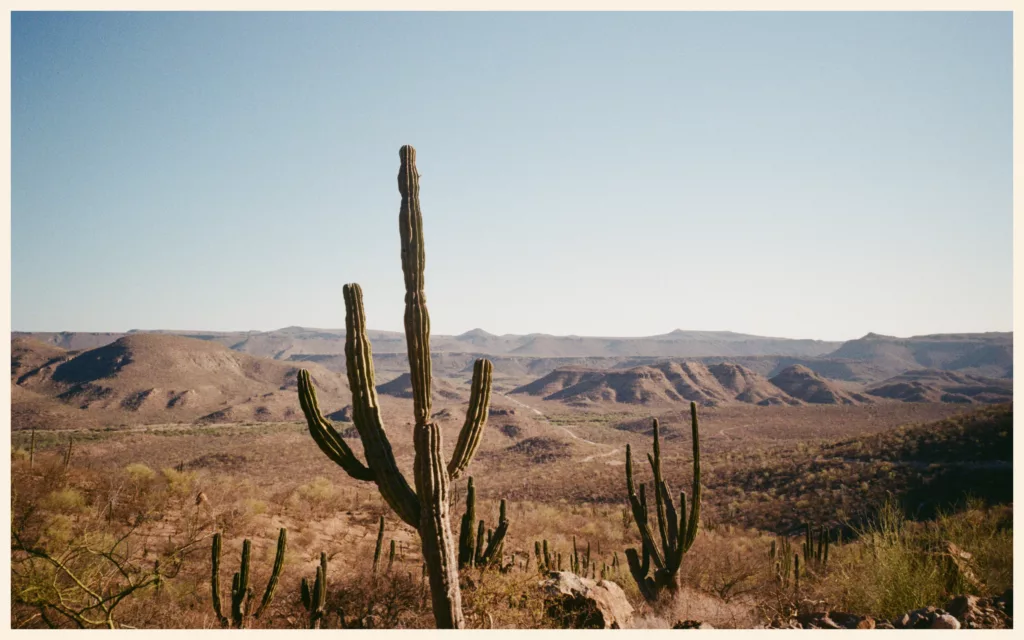
- The desert: about 190 km without trees or services between Atlantic City and Rawlins. Atlantic City has the last restaurant before Rawlins.
- Water: we left Pinedale with about ten liters each. Water sources are scarce (Diagnus Well, A&M Reservoir): ask cyclists who’ve just come through about their condition, and filter everything, the cows are everywhere.
- Heat: leave very early and don’t count on shade. White UV arm sleeves, soaked regularly, saved the day for us!
- Wind and storms: the wind blows hard, at your back if you’re lucky. On these plains, you’re the highest point around: keep an eye on the sky.


Where to sleep in Wyoming by bike
- In the parks: wild camping is prohibited. Yellowstone’s campgrounds keep sites for cyclists and hikers, around 10 dollars per person per night, showers extra (Cycling West). The park hotels are booked months in advance.
- Our campgrounds: Canyon Village and Grant Village in Yellowstone, Colter Bay and Jenny Lake in Grand Teton.
- Before Pinedale: a wild camp by a mountain lake, then the Strawberry Warming Hut, a shelter with an emergency phone, tables and chairs.
- With locals: through Warmshowers in Pinedale, and in a backyard in Atlantic City, where residents host cyclists.
- In the Great Basin: a wild camp at A&M Reservoir.
Resupplying without going broke
- Prices: supermarkets are expensive. Montana has no sales tax, unlike Idaho and Wyoming.
- Our typical menu: oatmeal with fresh fruit and nuts in the morning; tortillas filled with whatever we find (cucumber, tomato, canned chicken) at lunch; ramen, rice or pasta in the evening, on the stove. Even so, Julien has lost about ten kilos since we left.
- All-you-can-eat buffets: worth every dollar! The one in Colter Bay kept us going all day.
- Before the passes: carry two days of food. The café at the bottom of the passes had nothing to sell, and there’s nothing else before Pinedale.
Yellowstone, a volcano under your wheels
- The world’s first national park, created in 1872.
- A supervolcano: the park sits on a caldera. Its last big eruption, about 630,000 years ago, covered much of North America in ash.
- More than half of the planet’s geysers are in Yellowstone. Old Faithful, the most famous, erupts about every hour and a half.
- The Great Basin has its own history too: Oregon Trail pioneers crossed the Continental Divide at South Pass, and Atlantic City was born of the gold rush in 1868.
Your questions about bikepacking in Wyoming
Yes, on the park roads, shared with lots of cars and RVs. Hiking trails remain off-limits to bikes. Expect 20 dollars per person for a week (2024 rate), and 100 dollars more for non-residents since 2026.
No. The official route enters Wyoming between Yellowstone and Grand Teton, via Grassy Lake Road. To visit Yellowstone, you have to make a detour, for example via West Yellowstone.
In the park campgrounds, which keep sites for cyclists and hikers, around 10 dollars per person per night. Wild camping is prohibited.
More than 23 m (25 yards), and more than 91 m (100 yards) from bears and wolves. A bison can weigh 900 kg and run at 56 km/h.
With plenty of water (about ten liters each for us), a filter, UV arm sleeves and a very early start. Between Atlantic City and Rawlins, there are no services for about 190 km.
From the Red Rock Lakes refuge to southern Wyoming, we rode 1,155 km and 10,782 m of climbing in 19 days: 14 stages, plus a few town rides on rest days, 77 hours in the saddle.
The episodes to listen to (in French)
Episode 12: “Une bise aux bisons” (A kiss for the bison) (Idaho, the moose, the bear cub, Yellowstone and its bison)
Episode 13: “Une histoire de Grand Tetons” (A Grand Teton story) (Grand Teton, Jenny Lake, the passes, the hut of mice, Pinedale)
Episode 14: “Pédaler 145 km dans le désert sous 53 °C” (Riding 145 km in the desert at 53 °C) (Pinedale, the Great Basin, Atlantic City, A&M Reservoir)
They’re all on our podcast page, on Spotify, Apple Podcasts and Deezer. The episodes also tell what I left out here: our Italian dinner in Idaho, our calls home, our evenings with George… Montana is in part 1 and part 2. And the next chapter, Colorado, is coming in the next episodes! To support the blog, it’s this way!

This site uses Akismet to reduce spam. Learn how your comment data is processed.
Leave a Reply