
Bikepacking Montana on the Great Divide (part 2): from Helena to the gates of Yellowstone
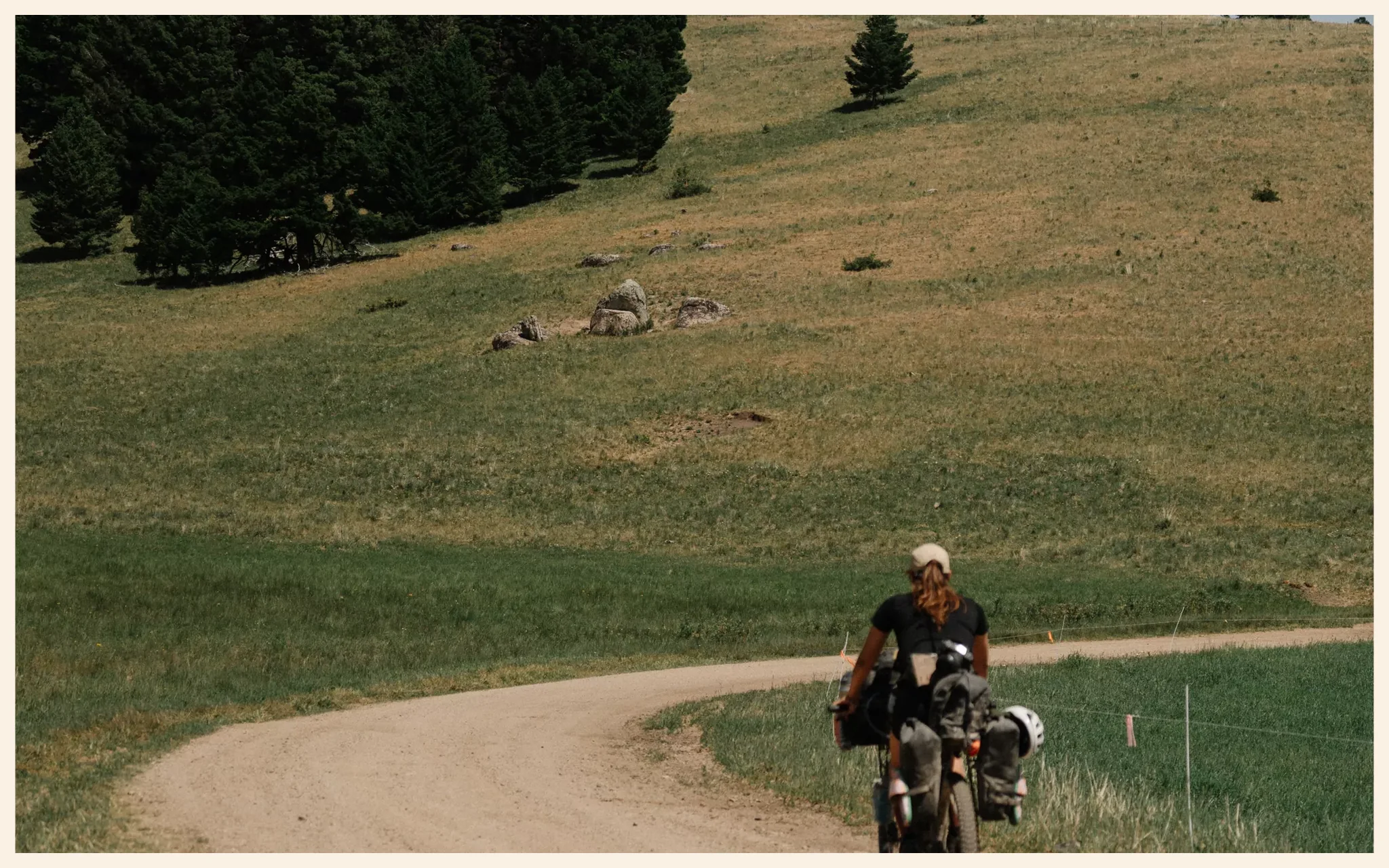
The second half of Montana is where the forests fade away, the horizon opens up… and water starts running short! In mid-July 2024, we left Helena, the state capital, and rode the Great Divide Mountain Bike Route (GDMBR) south: 515 km and 5,984 m of climbing in eight days on the bike, via Butte, the terrifying Fleecer Ridge descent, the Elkhorn hot springs and the ghost town of Bannack, all the way to the Red Rock Lakes, a stone’s throw from Idaho and Yellowstone.
In the podcast, Marie-Liesse and I told Jean-Mi everything as it happened. Here, I go back over the moments that stuck with us the most, and give you what you need to know to ride southern Montana: the route, the stages, the heat, water, where to sleep and how to survive Fleecer Ridge (and the flies).
In short
- When: July 13 to 20, 2024, the two of us, in the middle of a heat wave.
- The route: from Helena to Upper Lake, in the Red Rock Lakes refuge, via Boulder, Basin, Butte, Fleecer Ridge, Elkhorn Hot Springs, Bannack, Clark Canyon and Lima.
- The ride: 515 km and 5,984 m of climbing over 8 days on the bike (37 hours in the saddle), including a short 8 km day to reach the hot springs.
- The challenge: the Fleecer Ridge descent, said to hit -26%, and the heat: we often stop around 11 a.m. for lunch and a rest, then ride until sunset, which is very late in July.
- Sleeping: the Basin community hall (5 to 10 dollars per person), self-registration campgrounds where you pay with an envelope, a hot springs lodge and Warmshowers hosts.
- The people: a man just out of prison, a 77-year-old cyclist who snores like no one else, and Lynn and Chip, our grandparents of the road.


Our bike route through southern Montana
- Helena → Boulder → Basin: 83 km, with a long break in the shade in Boulder during the hottest hours.
- Basin → Butte, the copper town: 63 km.
- Butte → a self-registration campground: 61 km and 1,145 m of climbing, along an old railroad grade and past dry water sources.
- Self-registration campground → Fleecer Ridge → a campground 8 km from Elkhorn: 74 km and 1,271 m of climbing, with the -26% descent.
- Campground → Elkhorn Hot Springs: 8 km, and a whole day in the hot water.
- Elkhorn → Bannack → Clark Canyon Reservoir: 77 km, a detour to the ghost town, then a headwind.
- Clark Canyon → Lima: 58 km, on an old railroad grade rather than the official route.
- Lima → Upper Lake Campground, in the Red Rock Lakes refuge: 92 km without a single tree for shade.
| Day | Stage | Km | D+ | Time |
|---|---|---|---|---|
| 1 | Helena → Boulder → Basin | 83 km | 1,284 m | 6h45 |
| 2 | Basin → Butte | 63 km | 783 m | 4h39 |
| 3 | Butte → self-registration campground | 61 km | 1,145 m | 5h44 |
| 4 | Self-registration campground → Fleecer Ridge → campground | 74 km | 1,271 m | 5h55 |
| 5 | Campground → Elkhorn Hot Springs | 8 km | 56 m | 0h24 |
| 6 | Elkhorn → Bannack → Clark Canyon | 77 km | 400 m | 4h22 |
| 7 | Clark Canyon → Lima | 58 km | 362 m | 3h17 |
| 8 | Lima → Upper Lake Campground | 92 km | 683 m | 6h05 |
| Total from Helena to Red Rock Lakes | 515 km | 5,984 m | 37h12 |
Times are moving times, breaks not included.
All our tracks are on our Route & Stats page, “Banff > Sargents” section, and the details of each day are on Julien’s Strava.


What we lived through in southern Montana
Two Cokes and a second chance
South of Helena, the sun beats down so hard we’ve changed our clocks: we often stop around 11 a.m. for lunch and a rest, then ride until sunset, very late in July. In Boulder, siesta time finds us outside a bar with frosted windows. We push the door for a Coke. Behind it, a whole world: bowling lanes, dartboards, pool tables… and, all told, one waitress and one customer.
When it’s time to pay, I dig through my pockets: not enough cash for two Cokes. The waitress picks up my bills, then dips into her tip jar to make up the difference, as if it were the most normal thing in the world. We’re speechless!
The customer has long jet-black hair, almost white skin and a cane leaning against the bar. He wants to know everything: Canada, the bears, the border. Then, without us asking anything, he tells us he’s just out of seventeen years in prison. Youthful mistakes, which he regrets. We don’t try to find out more: if he’s out, he deserves his second chance. Luck, though, isn’t on his side. A disease is eating away at his bones, the state has cut his benefits, and he isn’t allowed to leave the country. Tomorrow, he has an interview to deliver pizzas.
“Do you have photos of Canada?” I hand him my phone. The mountains scroll under his thumb, and his eyes light up like a child’s in front of a shop window. Before limping off, he wants to buy us a drink. We refuse, of course. I never saw him again, and I still think about him often. That day, I realized how lucky I am: a passport to cross borders, legs to pedal, and the means to pay for this trip.
A sleepless night in Basin
Basin is a handful of houses. But every Great Divide cyclist knows its community hall, where you can sleep for 5 to 10 dollars. Waiting for the evening, we settle into the café, under a TV with only one topic: Donald Trump has just been wounded in the ear by a gunman, in the middle of a rally in Pennsylvania.
A customer turns to us. If the candidate had been killed, she explains very seriously, she would have picked up her phone without dialing a number and said: “Is it really war you want?” She’s convinced that someone, somewhere, is listening to her calls. We leave the café with more questions than answers.
In the hall, two young guys from Helena are heading to a music festival in Butte. At nightfall, Pascal shows up: 77 years old, the legs of a young man, and a passion for his own adventures, which he tells at the top of his voice while we try to sleep. We get the giggles, impossible to stifle! We laugh less an hour later. Pascal snores. Not a little snore: a tractor engine! Even Marie-Liesse, who usually sleeps like a log, wakes up. I spend the night whistling and throwing whatever comes to hand in his direction. Nothing works. In the morning, Pascal asks if everyone slept well. Dead silence.


Butte, America
On the road to Butte, I’m so tired that Marie-Liesse catches me pedaling with my eyes closed. “What are you doing?” “A technical nap.” We laugh about it now, because I didn’t fall!
Butte is like no other town in Montana. It grew on “the richest hill on Earth”, above its copper mines, with miners from Ireland and everywhere else. Here, people don’t say “Butte, Montana” but “Butte, America”, and they say it with pride. We mostly discover the free refill: unlimited Coke and iced tea with our burger, in a country restaurant. Cyclist heaven!
We stay with John, the Warmshowers host who has welcomed more cyclists than anyone in town, hundreds in total. His garage has become a dormitory, with bunk beds in every corner: most nights, about fifteen people sleep here, some days up to thirty, and John cooks for everyone. Tonight, we’re alone with him, and the big house tells another story: it was made for two, and his partner never shared his taste for these passing strangers. By opening his door so often, maybe he forgot himself a little. Before going to bed, he gives us two pieces of advice: leave Butte along an old railroad grade, and beware of a certain -26% descent.
Leaving the route (at last)
I have a confession to make. At the start of the Great Divide, I wanted to follow it 100%, like the racers who finish it in a few days. Every detour felt like a betrayal, even when we were both exhausted. Then Marie-Liesse got hurt, we had to skip a section known to be hellish, and dozens of cyclists admitted to us that they’d skipped it too, rather than push their bikes for three days. Since then, I can breathe. And we argue a lot less!
John’s old railroad grade turns into a lovely single track, and beyond it, Montana changes face. The conifer forests fade, the hills stretch as far as the eye can see. A long climb takes our breath away, literally and figuratively. It’s Monday morning, and we’re not at the office!
But we miscalculated our water. The ponds drawn on the map are dry, and the next water source is a day and a half away. At noon, we have lunch pressed against the shell of an abandoned trailer, the only shade for miles, a shade that’s shrinking before our eyes! That’s when two cars stop: a liter of water each, ice cubes included. Thank you, well-prepared strangers!
The evening campground is self-registration: an envelope in a box, and a pump whose water is so cold our improvised shower makes our legs ache. Around us, a man who lives year-round in his RV, and an uncle with two teenagers who are devouring the Great Divide at a hundred, sometimes two hundred kilometers a day. With our 50 kg, we bow down. The real masters of the place, though, are the chipmunks, little squirrels that steal anything lying around, even a book. Tonight, the bags sleep double-locked!


Fleecer Ridge, the upside-down wall
That morning, we’ve been riding for a month. Marie-Liesse, who cried on every Canadian climb, says it without hesitation: the hardest part is behind us. We’ve found our rhythm, even a routine. Long-distance travel is full of them, contrary to what we imagined.
Thirty kilometers in the cool of the morning, and we’re at the top of Fleecer Ridge, the most dreaded descent on the Great Divide in Montana, said to hit -26%. Many people go around it by road. We want to ride it. At the top, we meet two cyclists who have just climbed this wall from the other side, pushing. Barely out of breath. Superheroes!
Holding back a 50-kg bike on a slope like that, with the hip pack on your side and the camera banging across your chest, is a constant negotiation with gravity. Marie-Liesse goes first and, against all odds, does much better than me. When she turns around, I’m five meters behind her and, seen from below, on the third floor of a building. But we reach the bottom in one piece!
Further on, we find Gary, a Brit traveling lighter and in a bit more of a hurry than us, with a tubeless tire punctured on the descent. An hour of repairs, a plug that won’t hold, and a roadside burger, Gary’s treat to thank us. There are fifty kilometers left to the campground, in an area known for its bears, and we ride them in one go.
In the late afternoon, the sky turns orange. It’s not golden hour yet: it’s smoke from a wildfire, dozens of kilometers away. A few days earlier, near Helena, a water-bomber pilot was killed fighting one of these fires. We think about it for a long time that evening.


Elkhorn, the art of doing nothing
Eight kilometers away, Elkhorn Hot Springs offers exactly what we’d dreamed of: a wooden lodge in the middle of the mountains, and natural hot pools. We spend a whole day there doing nothing. Monumental bliss!
The only downside: the walls. So thin that at 5 a.m., we get a live broadcast of three 51-year-old American cyclists leaving, bursting with energy, packing up as if they were camping alone in the woods. In the next room, a guest ends up yelling, in English, that people don’t respect anything anymore. Under the covers, we cry with silent laughter.
It’s also in Elkhorn that we meet Lynn and Chip, a retired couple also riding the Great Divide. We click within three sentences. They leave a day before us, but we promise to meet up again.


Bannack, the town where time stood still
There are three days left to Lima, and our bags are almost empty. Luckily, we’re not traveling as two but as three. Our third companion is a cyclist’s journal, published five or six years ago on Crazy Guy on a Bike, a site of bike travel stories. He noted everything: every water source, every grocery store, almost every flower. He mentions a small country market a bit further on. With a journal that old, you sometimes find a closed door. This one opens onto an adorable grandmother and full shelves. Phew!
Lynn and Chip advised us to make a detour to Bannack. We expect a freshly repainted Wild West Disneyland. We discover about fifty log buildings from the 1860s, simply protected from time: the school, the hotel, the barber, the general store, the jail. Inside, the wallpaper, photos and furniture are still in place. We go from house to house like ghosts visiting ghosts!
A guide hears us speaking French and answers in perfect French: his great-grandmother was from Alsace. He tells us about the gold strike of 1862, the town filling up with thousands of prospectors in a few months, and even becoming, in 1864, the first capital of Montana Territory. Then the gold ran out, and everyone left. Bannack is now a state park, frozen in its last breath.


Clark Canyon, under the full moon
On the track to Clark Canyon, a headwind pins us in place. In the distance, two small colorful dots slowly grow bigger. It’s Sarah and Tom, two Brits who set off from Patagonia, heading for Canada, on the same bikes as us, Tumbleweed Prospectors. Half an hour of gear and handlebar talk in the middle of nowhere, then a precious tip: an old railroad grade leads to Lima much more easily than the official route.
At the Clark Canyon Reservoir campground, the pump is dry, and the brown lake water doesn’t appeal. We knock at Nicole’s, set up by the water. She gives us water and fruit, and lets us sleep under the shelter she booked for her friends. The sun sets, a huge full moon is reflected in the lake, the kids play around the fire, the dogs run everywhere. Marie-Liesse goes to bed. I stay a little longer, out of time.


Lima, base camp
The next day, we take Sarah and Tom’s railroad grade. We’re tired, out of food, and have nothing left to prove to anyone. In Lima, surprise: Lynn and Chip are there, but also Dino and Suzy, whom we met at our hosts’ in Helena, with some friends of theirs. Eight cyclists at the same motel, plus the three Americans from Elkhorn: Lima becomes Great Divide base camp!
We have dinner with Lynn and Chip. They met through cycling, have crisscrossed the United States and Canada under their own steam, ride as many kilometers as we do every day… and they’re vegetarian, when we feel like we’re running on meat alone. That evening, they become our surrogate grandparents!


Fly heaven
From Lima to the Upper Lake campground, it’s 92 km across the Red Rock Lakes refuge, without a single tree for shade. We planned to leave early. We forget the alarm. At 9 a.m., fresh as daisies, we discover that all the other cyclists have left. New challenge: catch them all and get to the campground first!
We ride alone for much of the day. A herd of pronghorns gallops almost alongside us, and there are so many deer we can’t photograph a landscape without one in the frame. Then we spot the three Americans. We tuck in behind each other, race position, and pass them with a big “see you tonight”. The others drop one by one. We arrive first! Everyone joins us within the hour: we’re the most loaded, but also the youngest.
The campground is superb: six sites, a lake below, a pink and purple sunset. And flies. Not flies buzzing around you, no: flies that climb all over you. Impossible to sit still; everyone eats while walking, jumping, flapping their arms. From a distance, we must look like a cult performing a ritual!
I finally find the only fly-free refuge: the toilets. I lie down on the cool floor, at peace at last. It doesn’t take Marie-Liesse long to find me… and join me. Until someone, strangely enough, wants to use the toilets! At nightfall, the flies disappear, and we all have dinner together, going over the day.


Goodbye, Montana
Montana was our first American state, and just over three weeks were enough for us to grow attached to it. We discovered American culture there: its burgers, its gas stations that feel like oases, its free-roaming herds by the roadside, its birds of prey and its deer around every bend. And above all its people, often far from our ideas, almost always disarmingly generous. The next day, we cross into Idaho, then Wyoming, heading for Yellowstone!
Practical info for southern Montana by bike
Riding in the heat
- In July, do as we did: stop around 11 a.m. for lunch and a rest, then make the most of the long evenings, as the sun sets very late.
- Carry more water than planned. In summer, the ponds and streams shown on maps can be dry, and so can some campground pumps (like at Clark Canyon). Filter what you find.
- Don’t hesitate to ask drivers and campers for water: we were never turned down!
Fleecer Ridge, the dreaded section
- The Fleecer Ridge descent, between Butte and Wise River, is one of the steepest on the Great Divide (said to hit -26%), on rocky, slippery ground. Most cyclists walk it, holding their bikes back.
- Helmet on, and stow anything that swings around (hip pack, camera).
- If you’re too loaded or too tired, a paved road along the river lets you avoid it.
Resupplying
- Between Butte and Lima, grocery stores are rare: carry at least three days of food.
- Online journals, like those on Crazy Guy on a Bike, list water sources and stores, but some are dated: check opening hours when you have signal.
- Food is expensive in the United States, especially at gas stations. Good news: Montana has no sales tax!
Where to sleep in southern Montana
- The Basin community hall: 5 to 10 dollars per person, well known to Great Divide cyclists.
- Self-registration campgrounds: you pay by slipping an envelope into a box. Some have a drinking water pump.
- Elkhorn Hot Springs: a lodge with natural hot pools, perfect for a rest day.
- Warmshowers: in Butte, John has hosted hundreds of cyclists, sometimes thirty in one night in his garage turned dormitory.
- Campers: when everything is booked, ask. Nicole lent us her shelter at Clark Canyon.
Wildfires and critters
- In summer, wildfires are common: an orange sky often signals a fire, even a distant one. Check fire maps (InciWeb) and road closures before setting off.
- Chipmunks steal anything lying around: close your bags, even for a minute.
- Around the Red Rock Lakes, the flies can be unbearable in July. Bring long clothes and repellent.
Butte and Bannack, Montana’s mining history
- Bannack: in July 1862, a gold strike there set off Montana’s first big gold rush. In 1864, the town became the first capital of Montana Territory. Today it’s a state park, with more than fifty period buildings.
- Butte: in the late 19th century, its mines made it one of the world’s top copper producers, hence its nickname, “the richest hill on Earth”. Its miners from Ireland and elsewhere gave it another nickname: “Butte, America”.
Your questions about southern Montana by bike
It’s a very steep, rocky descent between Butte and Wise River, said to hit -26%. Most cyclists walk it, holding their bikes back, and a paved road lets you avoid it.
At the Basin community hall (5 to 10 dollars per person), with Warmshowers hosts in Butte, in self-registration campgrounds, at the Elkhorn Hot Springs lodge or at the Clark Canyon Reservoir campground.
Yes, it’s a short detour from the Great Divide. Bannack is a state park where you can wander freely through about fifty buildings from the 1860s.
Ride early in the morning and late in the afternoon, take a long break during the hottest hours, and carry more water than planned: in summer, many water sources are dry.
We rode 515 km and 5,984 m of climbing in 8 days on the bike, including the rest day at Elkhorn Hot Springs, about 37 hours in the saddle.
Because Butte was built around its copper mines by workers from all over the world. Its residents still claim this nickname, rather than “Butte, Montana”.
The episodes to listen to (in French)
Episode 9: “Nuit blanche au Montana” (A sleepless night in Montana) (Boulder, Basin, Pascal, Butte)
Episode 10: “Les chipmunks contre-attaquent” (The chipmunks strike back) (the railroad grade, water, Fleecer Ridge, the fires)
Episode 11: “Le paradis des mouches” (Fly heaven) (Elkhorn, Bannack, Clark Canyon, Lima, Upper Lake)
They’re all on our podcast page, on Spotify, Apple Podcasts and Deezer. The start of Montana, from the Canadian border to Helena, is in part 1. And the next chapter, Yellowstone and Wyoming, is in episodes 12 to 14! To support the blog, it’s this way!

This site uses Akismet to reduce spam. Learn how your comment data is processed.
Leave a Reply