
Bikepacking in bear country: black bears, grizzlies and what we learned
Should you be afraid of bears when bikepacking in Canada or the American West? No, but you do need to be prepared. Between Calgary and Montana, we came across four bears, including a grizzly and a black bear five meters (16 ft) from Julien, then a cub in Wyoming, and nobody ever got hurt. In this guide, I tell you about our encounters and share everything we wish we’d known before setting off: how to tell a black bear from a grizzly, what to do if you meet a bear, how to use bear spray and how to store your food at camp.
In short
- Two species live along the Great Divide: the black bear, the most common, and the grizzly, bulkier and recognizable by the hump between its shoulders. Color means nothing: our first “black bear” was a grizzly!
- Our tally: a grizzly on day 2, a black bear five meters from Julien near Fernie, a cub on a sandy track in Wyoming. Zero injuries, a few hairs standing on end.
- Bear spray belongs within reach, never at the bottom of a bag. It’s banned in airplane cabins: buy it when you arrive.
- Food never sleeps in the tent: use a bear locker at campgrounds, or hang it between two trees at least 4 m (13 ft) off the ground when wild camping.
- If you meet a bear: stop, stay calm, don’t run. And keep your distance: rangers recommend at least 100 m (about 330 ft).
Black bear or grizzly: how to tell them apart
First reflex to forget: trusting the color! A black bear can be brown, cinnamon or almost blond, and a grizzly can look very dark in the rain. We learned that on our second day (I’ll tell you about it below). The real clues are the body shape, the face profile, the ears and the claws.
| Clue | Black bear | Grizzly |
|---|---|---|
| Body shape | fairly straight back, rump at least as high as the shoulders | a large hump of muscle between the shoulders, rump lower than the shoulders |
| Face profile | straight, from forehead to nose tip | dished, slightly concave |
| Ears | taller and more pointed | short and rounded |
| Front claws | short (under 5 cm / 2 in) and strongly curved | long (5 to 10 cm / 2 to 4 in) and only slightly curved |
| Weight | generally smaller | 180 to 680 kg (400 to 1,500 lb) depending on the region; in interior northern Canada, males weigh around 140 kg (310 lb) |
Sources: Parks Canada, Idaho Fish and Game (bear identification program) and Wikipedia (“Grizzly bear”).
As you’ve guessed, from a distance and with your heart pounding, it’s often impossible to tell. When in doubt, follow the same rules for both!

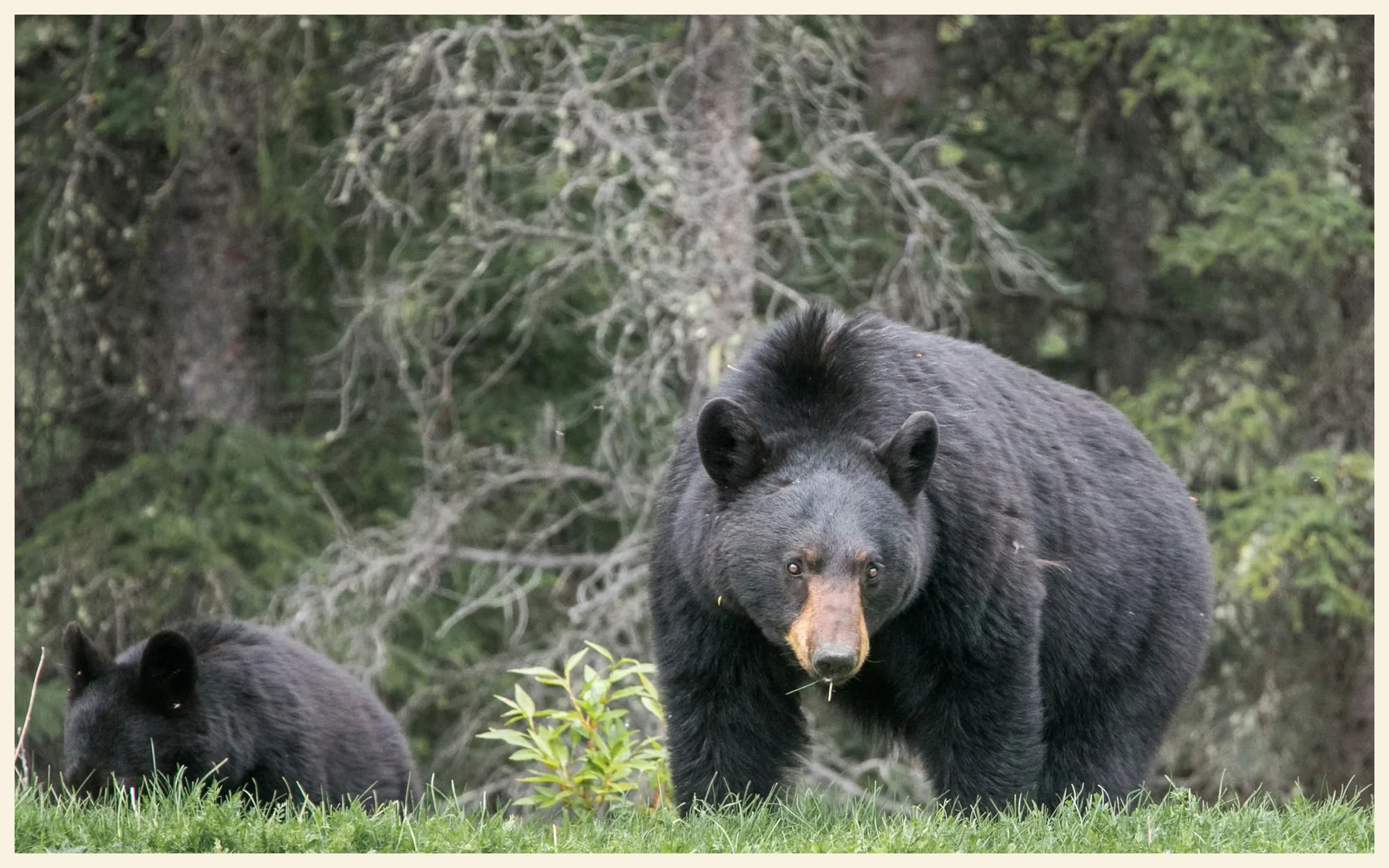
The grizzly: the shoulder hump and the dished face. © Thomas Lipke – Unsplash
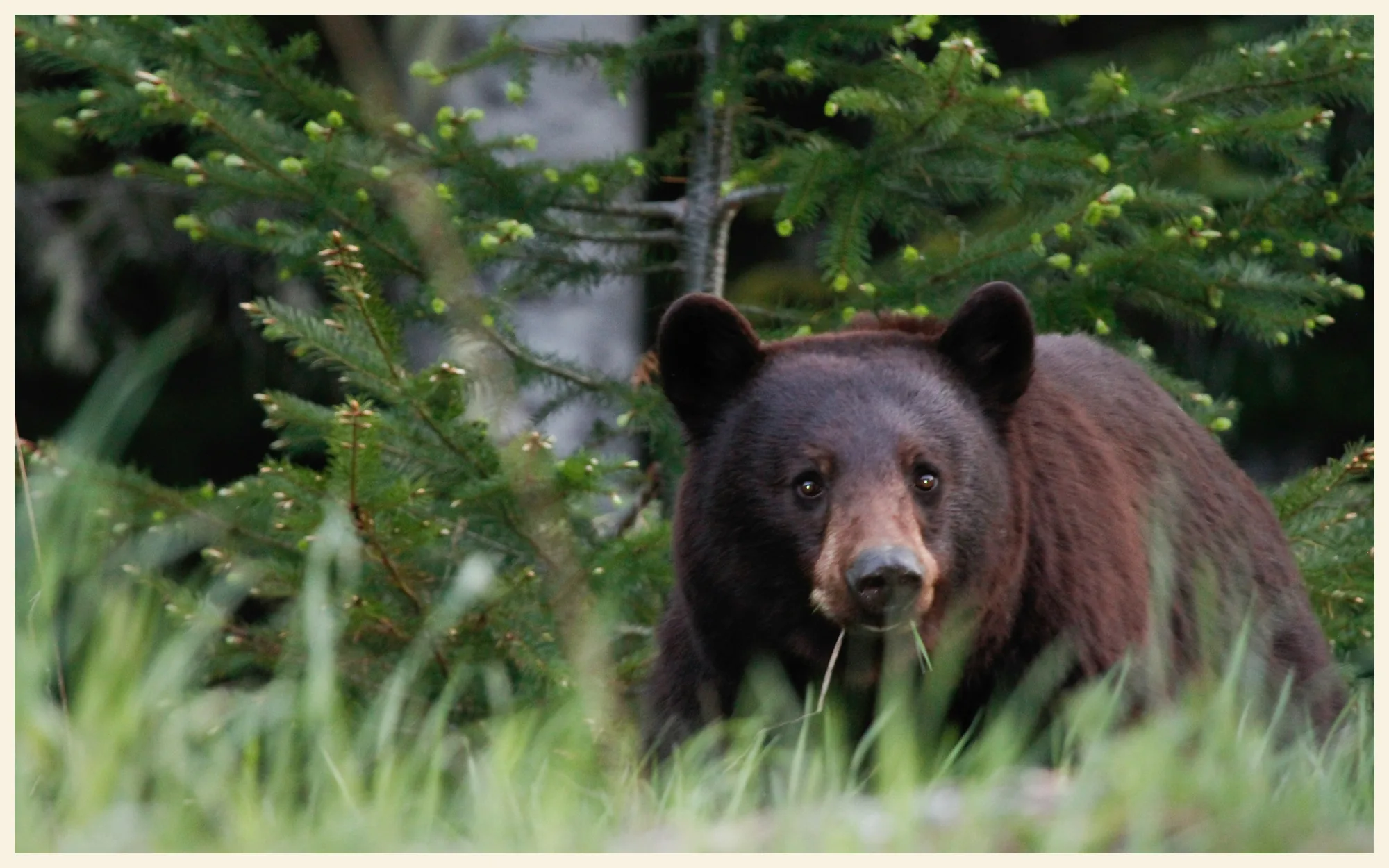
A black bear… that’s brown! The big pointed ears and straight face give it away. © Geoff Brooks – Unsplash
Where and when do you meet bears on a bike?
On the Great Divide Mountain Bike Route (GDMBR), the long gravel route that follows the Rockies from Canada to Mexico, bears live mostly in the northern part: Alberta and British Columbia in Canada, then Montana, Idaho and Wyoming, around Yellowstone. Wild grizzlies, about 60,000 today, are concentrated in Alaska and western Canada, with a few populations in the US Rockies, including the one in Yellowstone.
As for the season, bears are out from May to October, which is exactly the Great Divide riding season. They spend the rest of the year hibernating, up to five to seven months a year for grizzlies.
Our bear encounters
The day-two grizzly
June 2024, our second day on the Great Divide, in the rain. From the road, we finally spot our first bear, far away, with a few cars stopped around it. It crosses calmly, without even glancing at us. Such a gentle moment! That evening, in the showers at Boulton Creek campground, I proudly show the photo to Mel, a Canadian. She zooms in and smiles: “That’s not a black bear, that’s a grizzly!” Gulp. The animal that scared us most, met on day two, without the slightest drama.
Julien and the black bear five meters away
Between Elkford and Fernie, we split up for a day. Julien sets off alone on the official route and, for once, switches off his music and his bell: he wants to see a bear. Wish granted within the first few kilometers. A huge black mass, a head turning toward him… He claps, waves his arms, and the bear bolts into the bushes.
A few hours later, crossing a bridge, he comes face to face with a black bear. Five meters away. Rangers recommend staying a hundred meters back! First reflex (not the right one): pull out the phone to film. The bear starts following him. The phone goes back in the bag, the bear spray comes out. Julien backs away and yells, and the bear keeps coming, probably attracted by the banana strapped to his bag. Two or three endless minutes… then the animal wanders off.
A fly fisherman drives by in a pickup. When the bear comes back, Julien watches him give the perfect demonstration: big gestures, shouting, slapping the hood. The bear runs off without a second thought. His advice for a grizzly, on the other hand, is less reassuring: close your eyes and think very hard about your favorite place on Earth. We decided to stick with Parks Canada’s guidelines.
The cub on the sandy track
Wyoming, on the forest road to West Yellowstone. We’re chatting away when a crack comes from the brush on our right. Faint at first, then louder and louder. A cub bursts out and crosses right in front of our wheels!
A cub means a mother close by. And a mother separated from her cub by two bikes may charge. We shout as loud as we can, not to call for help (there’s nobody for miles), but so she knows exactly where we are. A fallen tree blocks the track: we have to lift the bikes and get around it on the edge of a drop, without ever stopping shouting. We reach West Yellowstone safe and sound, without ever seeing the mother. Black bear or grizzly? Impossible to say, the cub was too small for us to spot the famous hump.
What to do if you meet a bear
Here’s the behavior Parks Canada recommends, and the one rangers and locals repeated to us all the way down the Rockies.
- The bear hasn’t seen you: turn back quietly, without drawing its attention, and give it space.
- The bear has seen you: stop, stay calm and get your bear spray out. Above all, don’t run: a bear runs much faster than a human, and running away can trigger a chase. Talk to it in a calm voice and back away slowly.
- The bear approaches: make yourself look big, wave your arms, speak loudly (Julien’s fisherman technique). If it comes very close, use the spray.
- The bear attacks: Parks Canada distinguishes two cases.
- A defensive attack, by far the most common: a surprised bear, or a mother protecting her cubs. Use your spray. If it makes contact, play dead: lie on your stomach, legs apart, hands protecting the back of your neck, and stay still and silent until it leaves.
- A predatory attack, very rare: a bear that follows you, watches you intently or goes after your tent at night. In that case, do not play dead: use your spray and fight back with everything you’ve got.
And a tip from a friend: don’t do what Julien did, put the phone away! A bear photo isn’t worth a five-meter encounter.
Bear spray: how to use it
Bear spray is a pepper spray designed for animals. Parks Canada recommends carrying it at all times in bear country and learning how to use it before you go. What we took away:
- Within reach, always: on the handlebars, on your belt or in a frame pocket, never at the bottom of a bag. The day we split up, Julien had our only can… and I had nothing at all! Our solution: we never split up again in bear country. If you ride separately, carry one can each.
- Its limits: wind, rain, cold, distance and the expiry date all reduce its effectiveness. The bear has to be close enough, and you mustn’t be downwind. Check the date on the can.
- Flying: banned in the cabin, and most airlines also refuse it in checked luggage. The simplest option: buy it when you arrive. We bought ours at MEC, the big outdoor store in Calgary. Expect to pay about 60 Canadian dollars for a 225 g (8 oz) can (MEC’s listed price in 2026).
- The border: entering the US at Roosville, we didn’t declare it. It was in plain sight on the handlebars, and the officer didn’t ask us anything. To enter Canada, the rule is stricter: only a can whose label clearly states it’s meant for animals is allowed. When in doubt, declare it.
Sleeping and eating in bear country
This is where it all happens: a bear that has tasted human food comes back for more. And not to say hello! Parks Canada’s guidelines for camping in bear country:
- Never cook in or next to your tent. Parks Canada recommends cooking at least 100 m (330 ft) from your tent, downwind (one of their mountain park brochures says 50 m minimum).
- Store everything that smells: food, but also toothpaste, sunscreen and toiletries. In Banff, they have to spend the night in a car or in a bear locker. For washing up at camp, I’ve told you everything in our guide to staying clean while camping.
- At campgrounds: use the bear lockers. Many campgrounds in Canada and Montana have them.
- When wild camping: hang your food between two trees, at least 4 m (13 ft) off the ground and 1 m (3 ft) from the trunks. In some areas, a bear canister is mandatory.
- What we did: we always made sure to sleep at campgrounds with bear lockers. From Canada to Wyoming, we never had to hang our food.
Do bear bells actually work?
We left with them, of course. Result: we jingled over every bump, like two Swiss cows lost in the Rockies. According to the rangers we met, they’re mostly useful for spotting tourists from far away. The noise that works is your voice: talk, sing, clap your hands when the forest is dense, when a creek drowns out sounds or when the trail bends with no visibility. Bears don’t like being surprised, and neither do we!
Ovando: why you don’t mess with the rules
In Montana, we slept in the old Ovando jail, in a small village that welcomes Great Divide cyclists. The lady at the museum reminded us why everyone here repeats the same rules to travelers: in July 2021, a cyclist was killed by a grizzly in the middle of the night, at the village campground. No food in the tent, bear spray always within reach. We listened religiously, then went to sleep behind bars, hoping no bear would come knocking!
What we take away
Leaving Calgary, bears took up all the space in my head: every snapping branch was a grizzly. A few weeks later, fear had given way to respect, and to habits that never left us: spray on the handlebars, food in the locker, a voice that carries on blind corners. And one certainty: a bear seen from afar is a gift. Up close, we’d rather not!
Your questions about bears and bikepacking
Look at the body shape, not the color: a grizzly has a large hump of muscle between its shoulders, a dished face, short rounded ears and long claws. A black bear has a straighter back, a straight face and more pointed ears.
Stop, stay calm and get your bear spray out. Don’t run. If the bear hasn’t seen you, turn back quietly; if it approaches, wave your arms and speak loudly, and spray if it comes very close. Rangers recommend staying at least 100 m (330 ft) away.
It’s the defense Parks Canada recommends. You need to keep it within reach and know how to use it. Wind, rain, cold and the expiry date reduce its effectiveness.
Not in the cabin, and most airlines also refuse it in checked luggage. Buy it when you arrive in Canada or the United States.
Never in the tent: use campground bear lockers, or hang your food between two trees at least 4 m (13 ft) off the ground and 1 m (3 ft) from the trunks. Cook at least 100 m (330 ft) from your tent, and also store anything that smells (toothpaste, sunscreen).
Not really. Your voice works better: talk, sing or clap your hands on blind sections so you never surprise a bear.
From May to October, especially in Alberta and British Columbia. We saw several in our very first days on the Great Divide.
Podcast episodes to listen to
Episode 3: “Le blues des premiers jours” (the day-two grizzly, Mel), in French
Episode 4: “Une séparation risquée” (Julien’s bears between Elkford and Fernie)
Episode 7: “Une nuit en prison” (Ovando)
Episode 12: “Une bise aux bisons” (the cub on the sandy track)
To keep going, read our stories in Canada, in Montana and in Wyoming, and get ready to camp with our guide to staying clean while camping.
Cover photo: a black bear sow and her cub. © Joshua Reddekopp – Unsplash
Keep riding with us

This site uses Akismet to reduce spam. Learn how your comment data is processed.
Leave a Reply