
Bikepacking Canada on the Great Divide: from Calgary and Banff to Montana

Canada is where it all began… with two bikes stuck in Paris! In June 2024, we landed in Calgary to start our bike crossing of the Americas, then rode to Banff and the Great Divide Mountain Bike Route, the long gravel route that runs all the way down to Mexico. A few weeks later, we crossed the US border with our first bear scares, our first tears and our first great friendships on the road.
In the podcast, we told Jean-Mi everything as it happened. Here, I look back on those first weeks with a bit of hindsight, and give you everything you need to know to ride in Canada: the route, the stages, the bears, where to sleep and the mistakes not to repeat.
In short
- When: June 2024, at the very start of our trip, the two of us.
- The route: from Calgary to Banff via Cochrane and the Stoney Nakoda reserve, then the Great Divide from Banff to Eureka, in Montana.
- The ride: 564 km, 7,055 m of climbing and nearly 45 hours in the saddle, including town rides, over 7 stages: 2 days from Calgary to Banff and 5 days on the Canadian section of the Great Divide (391 km), through the Rockies.
- The terrain: expect about 1,000 m of climbing every 50 km, and gradients of up to 15%.
- Bears: we came across several, including a grizzly and a black bear five meters away. Bear spray is a must!
- Sleeping: campgrounds that are often pricey (around 30 dollars), self-registration campgrounds where you pay by leaving cash in a box, and Warmshowers hosts.


Our bike route through Canada
- Calgary → Cochrane → la réserve Stoney Nakoda → Stoney Park Campground, via the city bike paths, then back roads to avoid Highway 1: 78 km and 1,017 m of climbing, just over 6 hours in the saddle.
- Stoney Park Campground → Canmore → Banff, the official start of the Great Divide: 73 km and 976 m of climbing, again just over 6 hours.
- Banff → Pocaterra → Boulton Creek, in Kananaskis Provincial Park.
- Boulton Creek → Elkford via Elk Pass, into British Columbia.
- Elkford → Fernie, on two different routes: the Koko Claims, a brutal climb, for Julien; the road and a hiking trail for me.
- Fernie → Eureka, the border, and Montana.
| Day | Stage | Km | D+ | Time |
|---|---|---|---|---|
| 1 | Calgary → Stoney Park Campground | 78 km | 1,017 m | 6h07 |
| 2 | Stoney Park Campground → Banff | 73 km | 976 m | 6h10 |
| On the Great Divide | ||||
| 3 | Banff → Pocaterra Campground | 85 km | 1,094 m | 6h45 |
| 4 | Pocaterra → Boulton Creek Campground | 22 km | 320 m | 1h34 |
| 5 | Boulton Creek → Elkford | 82 km | 883 m | 5h39 |
| 6 | Elkford → Fernie via the Koko Claims (Julien’s route) | 105 km | 1,752 m | 10h01 |
| 7 | Fernie → Eureka | 97 km | 806 m | 6h36 |
| Great Divide, Canadian section | 391 km | 4,855 m | 30h34 | |
| – | Town rides in Banff and Fernie | 21 km | 207 m | 1h41 |
| Total in Canada, town rides included | 564 km | 7,055 m | 44h32 |
Times are moving times, breaks not included, and town rides are our short trips around town on rest days.
All our tracks are on our Route & Stats page, “Banff > Sargents” section, and the details of each day are on Julien’s Strava.


What is the Great Divide Mountain Bike Route?
It’s the most famous bikepacking route in North America: about 4,340 km from Banff, Canada, to Antelope Wells on the Mexican border, following the Continental Divide between the Pacific and the Atlantic, hence its name (bikepacking.com). You ride mostly on forest roads and dirt tracks, far from towns.
It’s also the playground of the Tour Divide, a fully self-supported race that starts from Banff every year on the second Friday of June. In 2024, the racers set off the day before we landed in Calgary. Their bikes weigh around twenty kilos; ours weighed at least 45 to 50 kg. And some of them had already finished while we were still struggling through the Rockies!
On the map, the Canadian section is the shortest. In your legs, it’s one of the hardest: the route crosses the Rockies, with pass after pass and an almost constant view of snow-capped peaks. Julien, of course, chose the toughest variants.
What we lived through in Canada
The big departure, without the bikes
June 15, 2024, Paris airport. We say goodbye to our families and friends for a year, a year and a half, maybe two. We’d been talking about this trip for so long that it had become a running joke among our friends. This time, it’s for real! Excitement, a knot in my stomach, last macarons and last croissant for a long while: I set off light-hearted, not really trained, but after a very solid preparation of farewell parties and dinners with friends.
At the oversized baggage drop, the security manager falls in love with our project. He promises us our bikes will travel strapped in and pampered, even meets us on the tarmac for a photo, and lets us leave reassured. We don’t take his number. In Calgary, in front of the oversized baggage belt, we wait… and nothing. The AirTag tucked into my bike is clear: it stayed in Paris.
Luckily, Monique and Mike, friends of Julien’s family and our very first hosts of the trip, pick us up at the airport. For four days, Mike shows us the best viewpoints in Calgary, comes with us for the last purchases and teaches us how to light our stove (we’re terrified of blowing it up). Monique pampers us like a grandmother. It rains for four days. The day the bikes finally arrive, the sun comes back with them. A sign!
Now we have to put them back together. Julien runs tubeless, and his tires, deflated for the flight, refuse to seat back on the rim. With no compressor, Mike pulls out a piece of string, trusses up the rear tire like a cycling Rambo and shouts at us to pump fast. The tire pops into place. Miracle!
Day one: cows, a reserve and a wad of dollars
On June 19, we leave Calgary on its surprisingly numerous bike paths before joining Highway 1. Four lanes, a wide shoulder, trucks brushing past: for a trip that’s supposed to happen on trails, not ideal. So we turn off onto the small roads running alongside it… until a “No trespassing” sign. Turning back means climbing the whole plateau again and losing an hour. We go through the gate!

Below us, an entire valley of cows, and maybe a bull or two. I want to turn back. We keep going. With our bags and our bear bells jingling at every bump, we must be the strangest thing they’ve ever seen: they bolt as we approach. I think they’re even more scared than I am!
After Cochrane, a small track leads us to the reserve of the Stoney Nakoda Nation. Mike and Monique had told us about the place of Indigenous peoples in Canada, a still painful subject, and about reserves you don’t cross without being invited. In front of a bison farm, we ask three men chatting there for permission. They grant it without hesitation, with one piece of advice: poverty has taken a heavy toll on the reserve, and so has alcohol, so whenever a car comes, stop and pull over.
The first thirty kilometers are completely calm, our ears straining for the slightest crack that might give away a bear. Then the cars arrive. The first one stops next to us, and its driver, clearly not very sober, tells us flatly: “It’s a reserve, man…” Three or four more follow, with the same threat of a fine if the sheriff finds us there. We apologize, we explain, and we finally leave the reserve safe and sound, with heavy hearts.
That evening, we find a campground in the middle of nowhere, Stoney Park Campground, for 30 dollars, a fortune for us. But sleeping out in the open with the bears is out of the question. And since there’s no signal, the owner only takes cash. Rookie mistake! I think of my grandfather, Daddy, who slipped me a wad of dollars when we said goodbye, with this instruction: “It’s not for buying drugs!” Daddy, rest assured: your first dollars paid for our first night in the tent.
That night, after 78 km, we pitch our tent on the American continent for the first time and wolf down our first ramen. Lighting the stove on our own, we think of Mike.


The first-days blues
The next day, 73 km via Canmore take us to Banff. The Great Divide finally begins. And for me, it begins badly. The first stage is supposed to be 35 km, but the planned campground is closed for works: we ride 85, with more than 1,000 m of climbing, a headwind and the fear of bears around every bend. That evening, I can’t even smile anymore, and for me, that’s a very bad sign!
The following days aren’t any easier. I cry in the evenings, I cry on the climbs. I miss my family and friends more than I’d imagined, and I feel like I’m just following Julien, who is much better prepared than me. He patiently tells me it’ll take my body a month to adapt. To cheer me up, he also points at the snowy peaks and promises we’ll only have snow up to our knees. I believe him every time!
And yet, all around us, everything is magical: pine forests crossed by streams, little waterfalls, and those white mountains ahead. I know some people would dream of being in our place. I end up noticing that the moment I break down comes a little later every day. And that after a good meal, everything’s better!
That first evening, in fact, a meal saves me. At a crossroads, we ask a man on a bike with his son for directions. He shows us a self-registration campground, where you pay by slipping cash into a box the ranger empties every week. He’s Jim. With Kristina and their two kids, aged about 5 and 8, they’ve just ridden 25 km. Seeing our faces, they offer to share their dinner. We have our ramen packets to offer. They pull out a barbecue, ribs and a dozen side dishes. At that point, sharing their meal or raiding it amounts to about the same thing! They leave us bars for the next day, and even soap.
Listen: episodes 2, “The big departure”, and 3, “The first-days blues”.


A grizzly, Mel and a “not very Canadian” happy hour
On the second day, in the rain, we finally spot our first bear, from a distance, from the road, with cars around. A gentle introduction! That evening, in the showers at Boulton Creek campground, we proudly show the photo to Mel, a Canadian. Her verdict: it’s not a black bear, it’s a grizzly! The animal that terrifies us the most, met on day two without the slightest drama.
A few minutes later, a car stops in front of our tent. It’s Mel and her husband: “That was really not Canadian of me, I should have invited you right away!” Off we go to their camper van, for a happy hour of chips in every color (Mel is a dietitian, but camping doesn’t count) and a beer. After weeks without alcohol, a single beer is enough to make us sway. We go to bed at 11 p.m., with the alarm set for 5 a.m. to tackle Elk Pass, the iconic Great Divide section that follows a power line along the ridge between Alberta and British Columbia.
Listen: episode 3.


A risky split between Elkford and Fernie
In Elkford, we decide to split up for a day, each with our own challenge. Julien wants to follow the official route over the Koko Claims, a brutal climb very few people take. I take Highway 3 to Fernie, 65 km away, via Sparwood. We’ll meet in the evening at Marie-Hélène and Johnny’s, our Warmshowers hosts. Julien makes me learn their address by heart, and I don’t really understand why. I soon will!
My day. Sparwood doesn’t have much going for it, apart from the Terex Titan, for a long time the biggest truck in the world, displayed by the roadside. After 35 km of cars flying past, I’ve had enough of Highway 3. I spot signs for the Continental Divide Trail, the long hiking trail that roughly follows the Great Divide, and decide to take it to Fernie. I don’t regret it: forests of firs and conifers, the smell of resin and no one for miles. The only catch: Julien has the bear spray! I cross paths with James and Stéphane, from the Adaptive Grand Slam Project, a group of athletes with disabilities we’d met that morning at the campground, cooling off under a waterfall. Then, a few hundred meters from Fernie, I fall hard on the gravel. I can’t get up. They’re the ones who pick me up, phone in pieces, and walk me to our hosts’ house. The address I learned by heart comes in handy!
Julien’s day. It starts under a blazing sun. To have a chance of seeing a bear, he turns off his music and his bell. Wish granted within the first kilometers of the climb, on a carpet of pine needles crackling under his tires: a huge black mass, a head turning toward him. He claps, waves his arms, and the bear runs off. Then the track turns into a boulder field. For 4 to 5 hours, he pushes and carries his 50-to-60-kg bike from rock to rock, for barely 8 km, with only 2 liters of water. Two motorcyclists, a father and son who set off from Alaska, push their bikes next to him: they finish the climb together and fall into each other’s arms at the top.
The descent is as steep as the climb: he slips, loses his camera filter, breaks his glasses. At the bottom, crossing a bridge, he comes face to face with a black bear, five meters away. Rangers recommend staying a hundred meters back! Julien takes out his phone to film, the bear starts following him, the phone goes back in the bag and the bear spray comes out. He backs away, yells, and the bear keeps coming, probably attracted by the banana hanging from his bag. Two or three endless minutes, then the animal wanders off. A fly fisherman then drives by in a 4×4. When the bear comes back, Julien watches him chase it away, waving his arms, shouting and banging on his hood. His advice for escaping a grizzly, on the other hand, is less reassuring: close your eyes and think really hard about your favorite place on Earth.
It’s between 35 and 40 °C, Julien is out of water, and the filter is in my bags. He drinks river water without filtering it, climbs one last pass on his last legs, and finally rides past a sign: “Good luck to all the riders”. Back on the asphalt, he bursts into tears. From exhaustion, from relief, and above all from pride! He arrives at 8 p.m., after 105 km, ten hours in the saddle and about twelve hours on the road, to find me… in a sorry state. We stay a few days in Fernie, until I can hold a handlebar again.
Listen: episode 4, “A risky split”.


Goodbye, Canada
From Fernie, there’s just one stage left to Eureka and the US border. Looking back, this Canadian section was short but intense: our first bears, our first tears, and a hospitality that carried us every time we faltered. Riding with snowy mountains ahead was a gift we only fully appreciated once we reached the deserts of the United States.


Practical info for a bike trip in Canada
When to go?
We were there in June, when the Tour Divide racers set off from Banff. There was still snow on the peaks and along the track on the passes, and it reached 35-40 °C on the hottest day. Pack clothes for all of it at once.
Terrain and elevation
- Expect about 1,000 m of climbing every 50 km, with gradients of up to 15%.
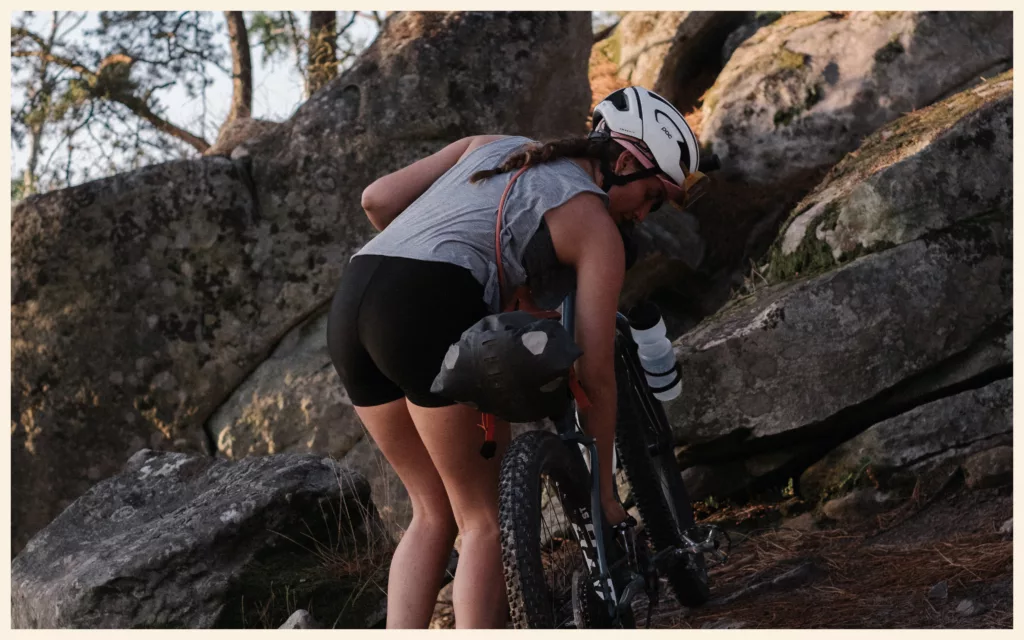
- The toughest variants of the Great Divide include hike-a-bike sections, even real boulder fields.
- The main highways (Highway 1, Highway 3) have a wide shoulder but heavy traffic. Bike paths in Calgary and trails like the Continental Divide Trail let you avoid them.
Bears
- Black bears and grizzlies are out from May to October, especially in British Columbia and Alberta. We saw several in just a few days.
- The black bear is the most common: smaller, it’s considered less aggressive. The grizzly, a subspecies of the brown bear, is much bigger, and you can recognize it by the hump on its back.
- Keep your bear spray within reach (not at the bottom of a bag) and stay at least 100 m away. If a bear approaches, make yourself seen and heard: big gestures, shouting, noise. Don’t run.
- Store food away from the tent, up high, or in the bear lockers at campgrounds. Don’t leave anything that smells good in the tent, and no cooking water in front of it.
- Bear bells are mostly decorative: according to the rangers, they mainly help spot tourists from afar.

Where to sleep?
- Campgrounds: often basic and fairly expensive (around 30 dollars), but we never needed to book on a bike. Many have bear lockers.
- Self-registration campgrounds: you pay by slipping cash into a box, and the ranger comes by to collect it. It works on trust.
- Wild camping: possible, as long as you stay out of sight of the road and take every precaution against bears. At first, we didn’t dare.
- With locals: the Warmshowers network opened the doors of Marie-Hélène and Johnny’s home in Fernie.
Money, water and logistics
- Cash: some remote campgrounds have neither signal nor card terminal. Always keep a few dollars on you.
- Water: there’s no shortage of rivers, but you need a filter or purifier. And more than 2 liters for a brutal climb!
- Flying with your bike: put an AirTag in your bike and note the contact of the person handling your oversized luggage. Our bikes arrived four days late.
- Tubeless: bring a way to seat your tires without a compressor, or a good string trick.
- First Nations reserves: you don’t cross them without permission. Ask, and respect the answer.


Your questions about bikepacking in Canada
In Banff, Alberta. The route runs about 4,340 km to Antelope Wells, on the Mexican border. Its Canadian section goes from Banff to the US border near Eureka (Montana): 391 km and 4,855 m of climbing for us.
Allow two days. We rode 78 km on the first day to Stoney Park Campground, via Cochrane and the Stoney Nakoda reserve (with the permission of its residents), then 73 km the next day via Canmore: about 150 km, 2,000 m of climbing and just over 12 hours in the saddle. Calgary’s bike paths and small roads let you avoid a good part of Highway 1.
We rode it in 5 days and about 30.5 hours in the saddle, plus a few rest days in Fernie. Tour Divide racers do it much faster.
Above all, you need to be prepared: bear spray within reach, food stored away from the tent, and noise if a bear approaches. We came across several, including a grizzly and a black bear five meters away, without incident.
In campgrounds (no booking needed on a bike, around 30 dollars), self-registration campgrounds, wild camping out of sight of the road, or with locals through Warmshowers.
We were there in June, when the Tour Divide leaves Banff: there was still snow on the peaks and on the passes. Keep in mind that bears are out from May to October.
The episodes to listen to (in French)
Episode 2: “Le grand départ” (The big departure) (the airport, the bikes stuck in Paris, Mike and Monique, day one)
Episode 3: “Le blues des premiers jours” (The first-days blues) (the tears, Jim and Kristina, the grizzly, Mel)
Episode 4: “Une séparation risquée” (A risky split) (Elkford-Fernie, each our own way, Julien’s bears)
They’re all on our podcast page, on Spotify, Apple Podcasts and Deezer. Next up is Montana, in episodes 5 to 11! For more stories, it’s this way, and to support the blog, that way!

This site uses Akismet to reduce spam. Learn how your comment data is processed.
Leave a Reply