
Coros Dura review after three months of bikepacking
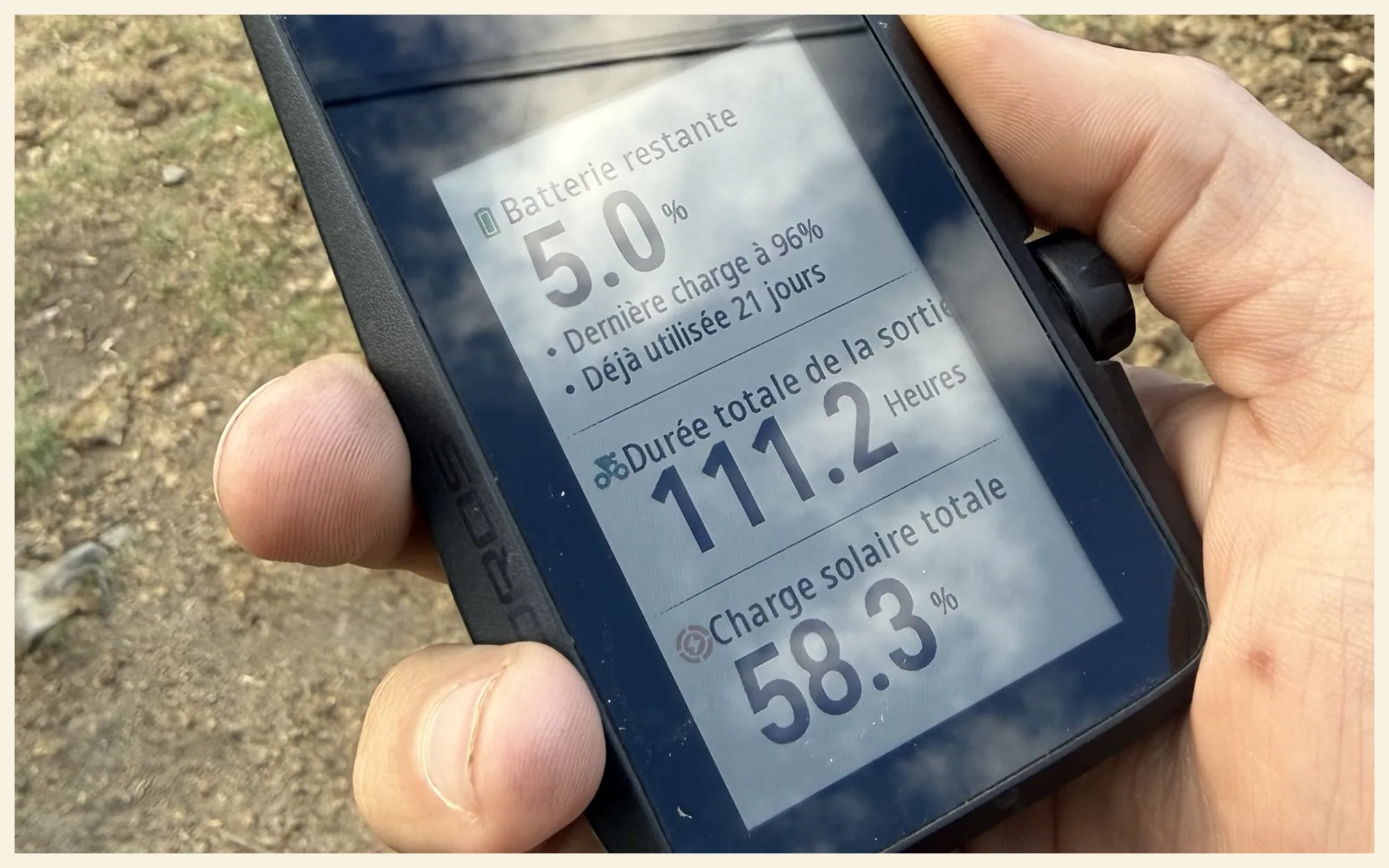
Written in November 2026 in Bolivia, after three months and 2,000 to 3,000 km with the Coros Dura on my handlebars, from Ecuador to Bolivia. We’ll update it at the end of the trip. Updated on November 9, 2026, with the November 2 software update.
The Coros Dura is the bike GPS you need if you’re heading off for a long time and never want to think about charging your bike computer again. I’ve been riding with it since August, in Ecuador, 6 to 8 hours a day, and I charge it roughly every twenty days. For navigation, it does everything I need, simply, for about €250. It won’t replace a Garmin if you train with a coach, but for bikepacking, I can’t fault it… except that it has just been replaced by a Dura 2 that costs twice as much!
In short
- Battery life: 6 to 8 hours of riding a day for about twenty days without charging. The small solar panel helps, under the Andean sun.
- Navigation: you import your GPX track into the Coros app, you sync, and off you go. World maps download by region.
- The screen: readable in full sun and in the rain, plus a dial on the side to scroll through the menus with gloves on.
- Durability: not a single failure or bug so far, through rain, dust, cold and heat. But I’ve never dropped it.
- The price: about €250 in Ecuador. The Dura is no longer made; its successor, the Dura 2 Solar, costs around €500.
- Who it’s for: long-distance bikepacking and ultra-distance. For training and racing, I’d stick with a Garmin.
Pros
- About twenty days of battery life: 111 hours of riding on my last charge
- Simple navigation: GPX track, app, GPS
- A screen you can read in the sun and in the rain
- A dial you can use with gloves on
- It fits on a Garmin mount
- Automatic sync with Strava
- About €250
Cons
- The screen seems fragile in a crash (a friend’s cracked)
- Less complete than a Garmin for training
- It’s no longer made, and its successor costs twice as much
Why I ditched my Garmin
For the first half of the trip, from Canada to Ecuador, I rode with a Garmin Edge 1040 Solar, the brand’s top-of-the-range GPS. On the Great Divide, it guided me flawlessly, with tracks downloaded from bikepacking.com. Then, in Ecuador, the screen turned completely brown and the touchscreen stopped responding.
I contacted Garmin customer service several times. Their answer: to get a replacement, I had to send the GPS back to customer service… in France. I was in Ecuador, on a bike, for another year. In other words, never! For a world-famous brand, with stores all over Latin America that could have swapped it on the spot, I just didn’t get it. That’s what made me switch brands!
The Coros Dura in numbers
Coros, a brand known for its sports watches, launched the Dura in 2024, its first bike computer (DC Rainmaker). Here’s what the brand and the reviews announce:
| Spec | Coros Dura |
|---|---|
| Claimed battery life | 120 hours of GPS, plus up to 2 hours of riding gained per hour of sun on the solar panel |
| Screen | 2.7 inches, touchscreen, MIP type (readable in full sun) |
| Controls | touchscreen and digital dial on the side |
| Weight | about 100 g (without the mount) |
| Water resistance | IP67 (dust and immersion) |
| Storage | 32 GB |
| Launch price | €289, mount included |
Sources: the5krunner, Cyclingnews, bikepacking.com, Coros.
Battery life: its real strength
This is where the Dura won me over. On riding days, I’m in the saddle 6 to 8 hours with navigation on, and I go about twenty days without plugging it in. Proof in the photo at the top of the article: on my last charge, it showed 21 days of use and 111 hours of riding, with 5% battery still left. The small solar panel has a lot to do with it: the screen shows 58% “total solar charge”. Here, between Ecuador and Bolivia, we get a lot of sun, and you can tell!
On a long trip, that changes everything! No more hunting for a socket every evening at a restaurant, a hotel or our hosts’ place. On stretches of several days without electricity, I don’t even think about it anymore.
Navigation: simple and effective
- Tracks: I download my GPX track, import it into the Coros app on my phone, sync it with the GPS, and off I go. Nothing more to it.
- Maps: you download the regions of the world you need, and then you can create your own route.
- Rerouting, even without a signal: since the November 2, 2026 update, the Dura recalculates your route without mobile signal. You need to have downloaded the maps of the region in the Coros app and keep your phone connected via Bluetooth. I’ve just installed the update and haven’t tested it yet: I’ll add to this review as soon as I have.
To plan multi-day stages, I still use komoot on my phone, like on the Great Divide.
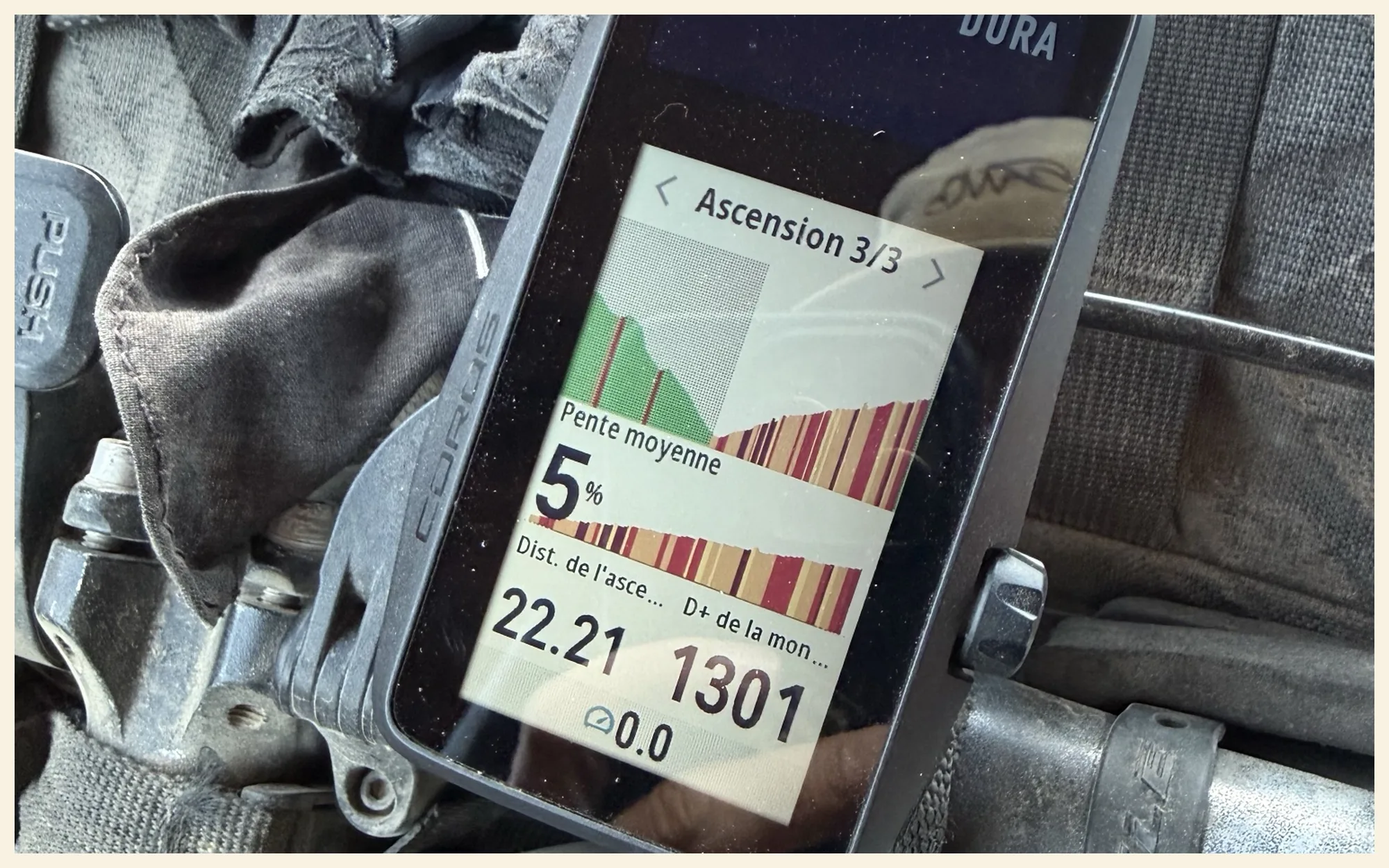
On my handlebars, the climb screen: the average gradient (5%), the distance (22 km) and the elevation gain (1,301 m) of the climb.
The screen and the dial
The screen is very readable, in full sun as well as in the rain. And Coros had a very clever idea: a small dial on the side that lets you scroll through the menus without touching the screen. With gloves on, in the rain or in the cold of the Andes, it’s perfect!
Durability: no issues, but watch out for crashes
Rain, dust, cold, heat: no failure, no bug so far. To be honest, I bought it fairly recently, and I’ve never dropped it. A friend dropped his, and the screen cracked. It looks quite fragile on that front: protect it in a crash, or choose a mount that holds it securely.
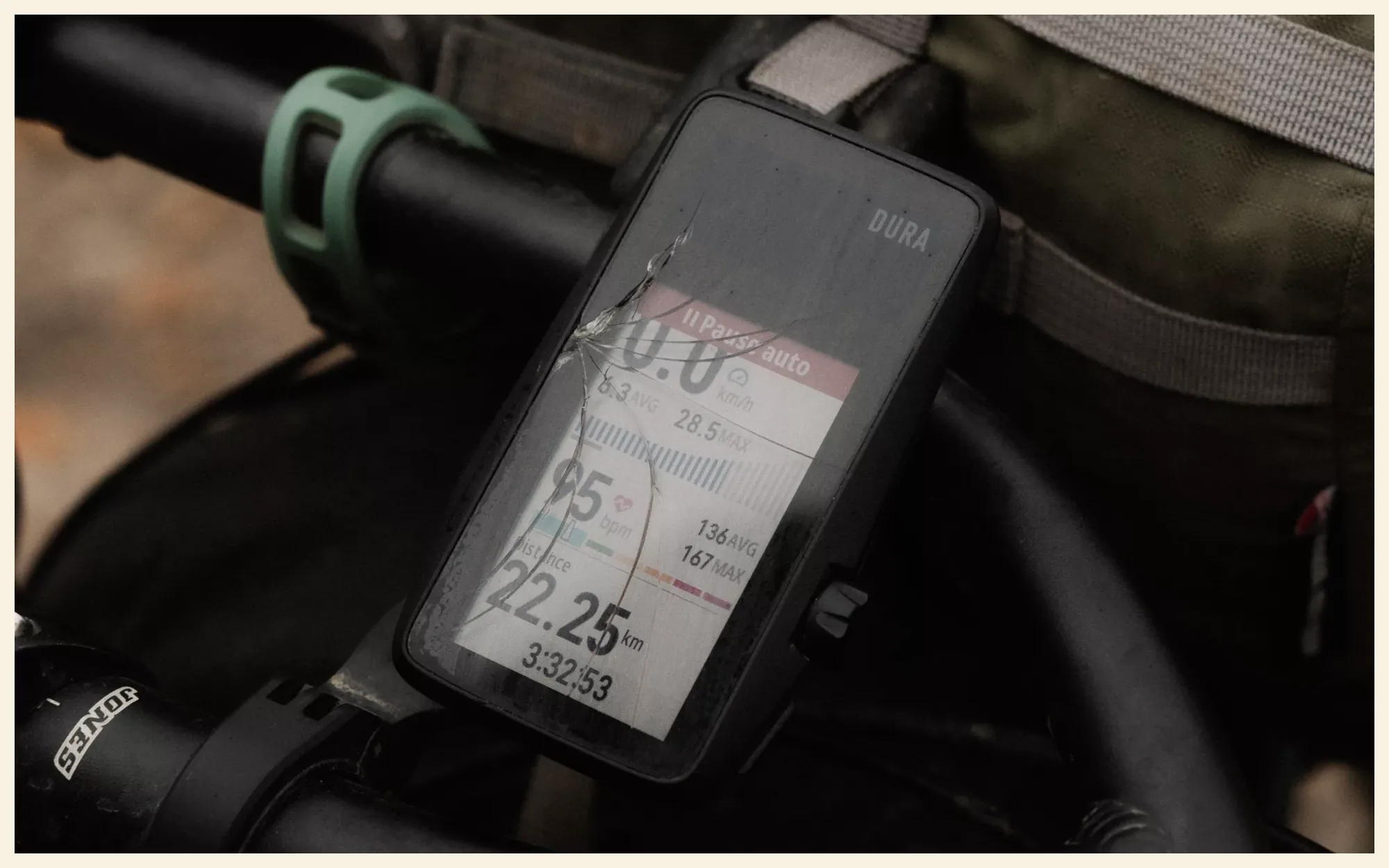
My friend’s Coros Dura screen, cracked after a crash.
The mount
Nice surprise: I simply reused my Garmin mount, and the Dura clicks onto it with no problem! If you’re switching from Garmin to Coros, you don’t need to change your mount.
The app and Strava
The Coros app is synced with my Strava account. I refresh my activities in the app, and they go straight to Strava on their own. Nothing else to do.
What I miss compared to my Garmin
Honestly? Nothing! For me, the Garmin is a more professional GPS, more useful if you plan training sessions or work with a coach. But if you want a simple GPS, just for navigating, with a few features and crazy battery life, the Coros Dura is very, very good.
The price and where I bought it
I bought it in Ecuador, in a shop near Quito, Tatou WS, for about €250. I’d buy it again without hesitation: for me, it’s the best value for money for a reliable bike GPS with that kind of battery life.
The November 2026 update: what changes for the original Dura
Good news for owners of the first Dura: Coros promised to keep updating it, and it’s doing so. The November 2, 2026 version brings four new features:
- rerouting without mobile signal, with the maps downloaded in the app and the phone connected via Bluetooth;
- the ability to start a training session in the middle of a ride;
- support for tire pressure sensors;
- a live power curve, for those who ride with a power meter.
The Dura 2 Solar keeps a few exclusive features: it shows upcoming climbs without a loaded route, pauses a session so you can resume it at the same point, and measures heart rate recovery after exercise.
For me, on a bikepacking trip, the real novelty is rerouting without a signal: in the Andes, we sometimes go days without a single bar. Tire pressure sensors and the power curve, I have no use for.
Sources: Coros (Dura release notes), the5krunner, Todo Mountain Bike.
Coros Dura or Dura 2 Solar: which one should you choose?
Bad news if you want one: the Dura is no longer made. Coros is launching its successor, the Dura 2 Solar, on November 3, 2026, at €499 without a mount, roughly twice the price of the first one. Coros keeps updating the original Dura’s software: the latest version dates from November 2, 2026.
| Coros Dura | Coros Dura 2 Solar | |
|---|---|---|
| Screen | 2.7 inches, touchscreen | 3.5 inches, touchscreen, edge to edge |
| Controls | touchscreen and dial | touchscreen, buttons and voice control, no more dial |
| Claimed battery life | 120 hours of GPS, plus solar | 120 hours of GPS, plus solar (unchanged) |
| Mount | included | sold separately, or in a bundle |
| Price | €289 at launch | €499 without a mount, €549 with |
Sources: the5krunner (Dura 2 Solar specs), the5krunner (Dura 2 Solar vs Dura), Tour, Cyclingnews, Escape Collective.
One difference matters to me: the Dura 2 no longer has a dial, the one that lets me do everything with gloves on. It replaces it with buttons and voice control.
I haven’t tested the Dura 2. But if you can still find a Dura, new or used, for around €250, for bikepacking, I’d grab it without hesitation.
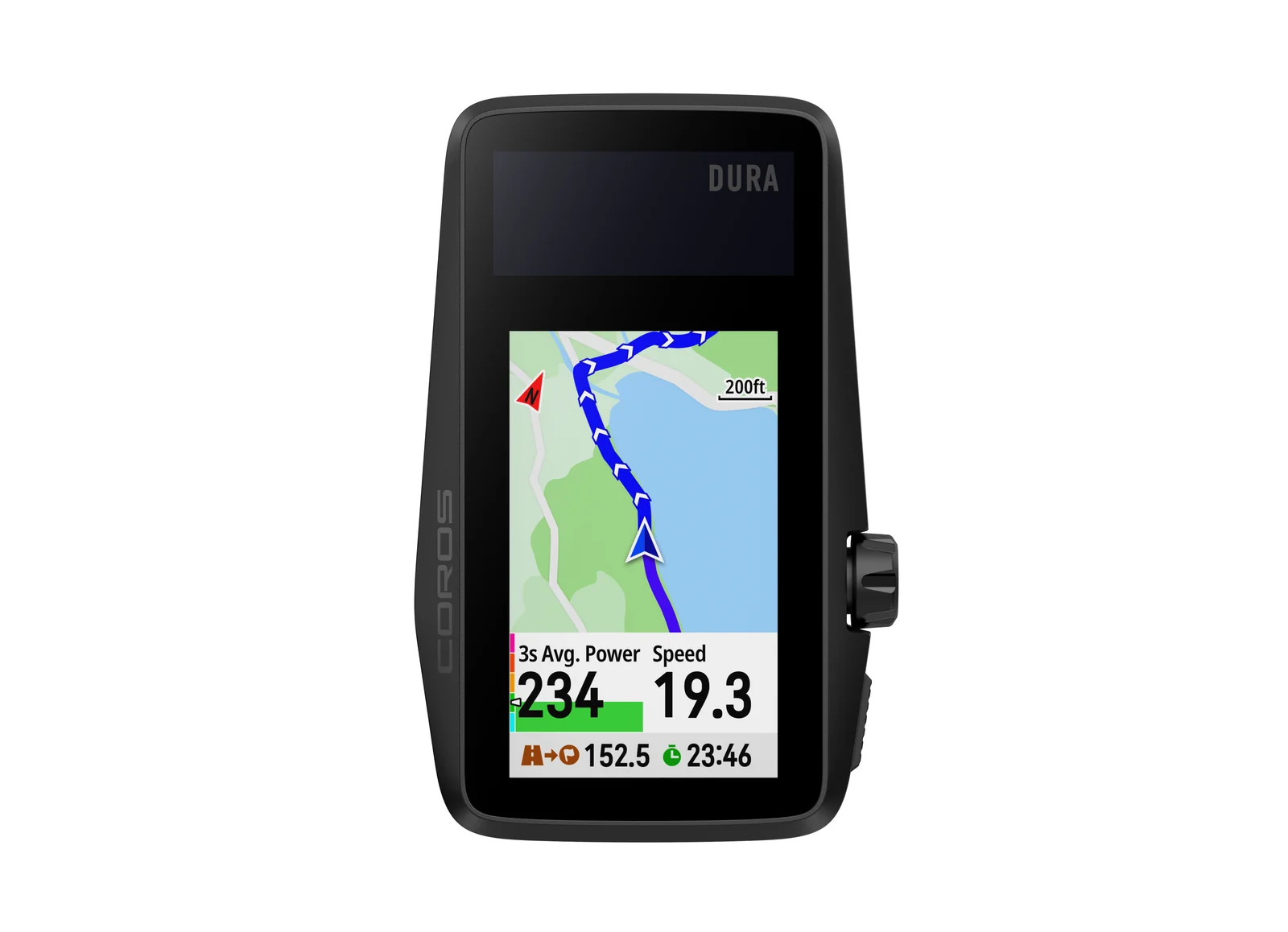
The Coros Dura (2024). © COROS
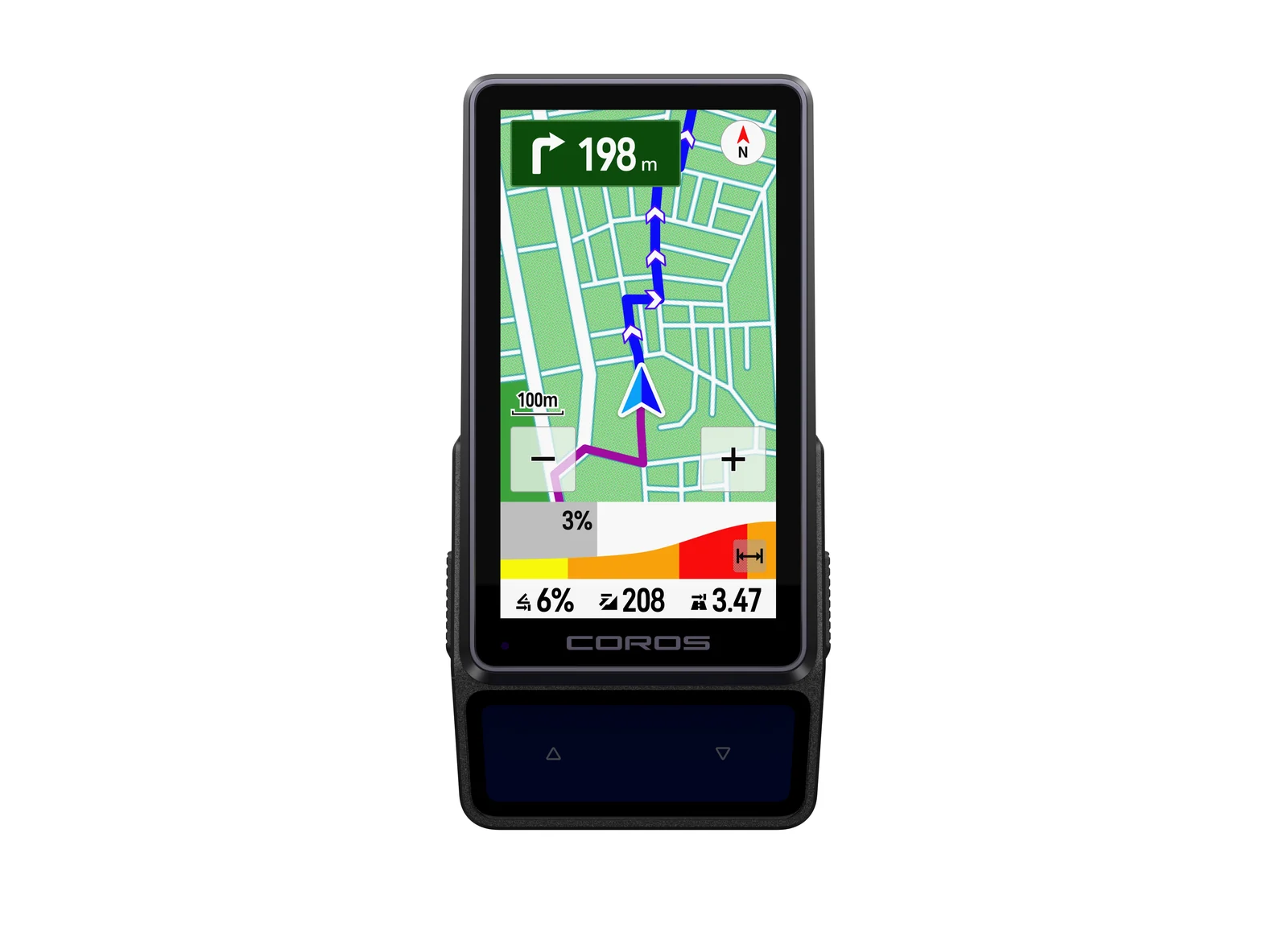
The Coros Dura 2 Solar (2026). © COROS
Who it’s for, and who it isn’t
| Who | My take |
|---|---|
| Long-distance bikepacking | Yes: battery life and simplicity are exactly what you need |
| Ultra-distance (bikepacking races) | Yes: a track to follow, and no more charging every night |
| Weekend rides | Yes, if you just need to navigate; it’s almost too much battery life |
| Structured training, road racing, working with a coach | No: a Garmin handles sessions and data much better |
My verdict
The Coros Dura is a GPS you forget about: I load my track, ride for twenty days, charge it. On a long trip, that’s all I ask of it. I’ll update this review at the end of the trip to tell you whether it made it all the way to Ushuaia. See you at the end of the world!
Your questions about the Coros Dura
Coros claims 120 hours of GPS. On my last charge, while traveling, I did 111 hours of riding over 21 days, and there was still 5% battery left, with help from the solar panel under the South American sun.
Yes, when the weather is good: according to Coros, one hour of sun can add up to two hours of riding. For me, it clearly slows down the battery drain.
Yes, thanks to the dial on the side, which lets you scroll through the menus without touching the touchscreen.
Yes, since the November 2, 2026 update. Download the maps of the region in the Coros app and keep your phone connected via Bluetooth: rerouting works without mobile signal.
Mine fits on my old Garmin mount, with no adapter.
For bikepacking and simple navigation, the Coros Dura, for its battery life and price. For structured training and working with a coach, a Garmin Edge is still more complete.
The Dura 2 Solar has a bigger screen (3.5 inches versus 2.7), buttons and voice control, but it loses the dial. The claimed battery life doesn’t change (120 hours of GPS), and the price goes from €289 at launch to €499 without a mount. Since November 2026, both reroute without a signal; only the Dura 2 shows climbs without a loaded route.
It launched at €289, mount included. I paid about €250 for mine in Ecuador, in a shop near Quito.
It’s no longer made since the Dura 2 Solar arrived in November 2026. You can still find it in some shops and secondhand.
Going further
- All our gear, weighed item by item: our Setups page.
- My gear review after 20,000 km is coming in December.
- The Great Divide, where I was still using my Garmin: our story of Canada by bike.

This site uses Akismet to reduce spam. Learn how your comment data is processed.
Leave a Reply